.svg)

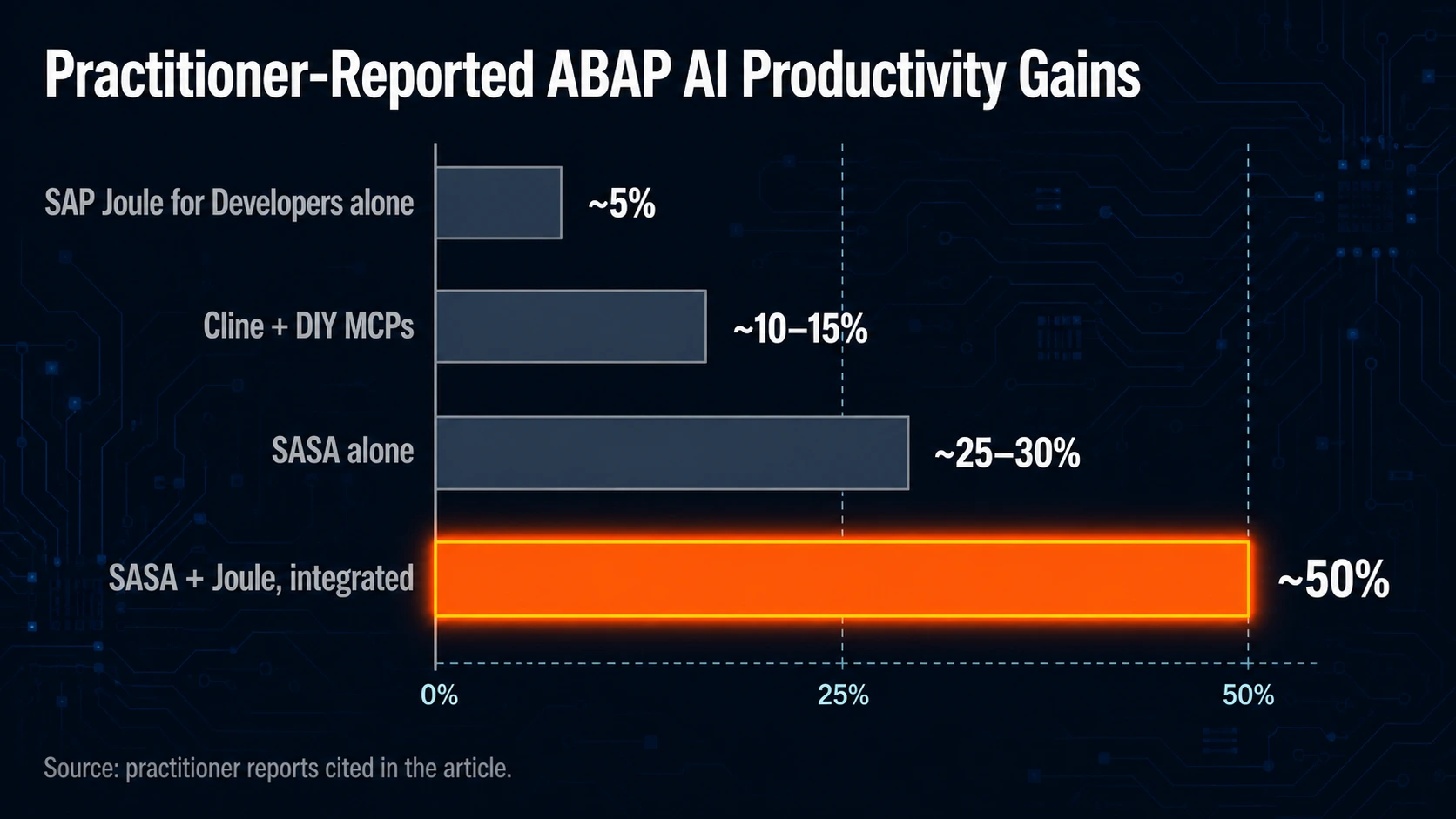
ABAP AI is finally production-grade, but the productivity claims have outrun reality. Vendor decks talk about 30%+ improvements. Practitioners running real-world workloads are reporting closer to ~5% from SAP Joule for Developers and ~10–15% from agentic tooling like Cline with custom MCPs. The gap between those numbers is informative: isolated tools tend to deliver isolated gains, and the SAP teams getting traction this year are the ones converging on fewer, more specialized tools rather than assembling more of them.
This piece walks through the seven ABAP AI tool categories most SAP teams are evaluating in 2026, where each one fits well, where each one tends to hit a limit, and the workflow pattern that's starting to emerge as integration matures. We work in this space, so we have a point of view — and we'll be transparent about where AiFA Labs' SASA fits in the picture. The intent is to give SAP teams enough to make their own call.

The Honest Productivity Baseline
The numbers practitioners are reporting in 2026:
- SAP Joule for Developers: ~5% productivity improvement at the developer level. Joule helps the moment of writing — refinement, completion, unit tests — but doesn't reshape how requirements become code.
- Cline with custom MCPs: ~10–15% productivity when MCPs are configured for SAP context. Strong agentic generation; the trade-off is the assembly and maintenance work.
- Vendor headline numbers ("up to 30%"): achievable in narrow scenarios, but harder to sustain at program scale once real ECC custom code is in the picture.
The pattern behind the gap is straightforward. Individual coding speed compounds badly with everything an isolated tool doesn't do — gathering business context, validating against live SAP systems, auditing changes, coordinating migration backlogs. Keystrokes get faster; the program clock keeps ticking.
The shift in 2026 is less about typing speed and more about where AI sits in the workflow:
Functional spec → AI generates technical spec → AI proposes implementation plan → Developer reviews plan → AI generates code → Developer refines and validates.
Tools that handle only the last two steps leave the larger gains on the table. The interesting question for 2026 is which tools handle the first four — and how they hand off to the IDE-resident layer once code reaches the workbench.
What ABAP AI Actually Delivers Today (and Doesn't)
Where AI is genuinely earning its keep right now:
- Test script generation — unit tests for global classes (public, protected, and private methods).
- Code vulnerability scanning.
- Naming convention validation.
- Code pattern checks against the team's standards.
Where AI is still bracketed without the right grounding:
- Deep SAP business context — custom tables, BAPIs, the actual semantics of a specific S/4HANA tenant.
- Clean Core compliance. Even strong tools land roughly 20–40% of generated code in compliance on the first pass.
- Migration program coordination. Not a code problem — an orchestration problem.
- Audit-ready governance of AI-assisted changes.
The reason for the gap is context. The formula now consensus among practitioners:
Prompt + MCP + LLM = Usable Output.
Without a Model Context Protocol layer feeding SAP-specific context into the LLM, the model hallucinates. With it, output becomes shippable. That makes the MCP layer one of the more important questions for any team adopting ABAP AI — whether it's bought, built, or borrowed.
How the Tool Categories Compare
There are six categories of ABAP AI tools SAP teams are realistically evaluating, plus a seventh worth naming because it's where AiFA Labs has been spending most of its time. None of these tools is wrong; each fits a slightly different shape of work.
SAP Joule for Developers
SAP's design-time AI assistant inside ABAP Development Tools for Eclipse, trained on 250M+ lines of ABAP and 30M+ lines of CDS. Free through September 2026 (promotional period). Strongest fit for refining and completing code already in the workbench, explaining legacy code, and generating unit tests.
- Where it fits well: Native SAP context, cloud-compliant suggestions, in the IDE most ABAP developers already use.
- Where teams tend to want more: Joule helps the moment of writing rather than the moment a requirement turns into code. The ~5% practitioner number reflects that scope, not the quality.
ABAP MCP and the ABAP Cloud Extension for VS Code
Announced at SAP TechEd 2025, scheduled for Q2 2026 general availability. Brings agentic patterns into a SAP-native VS Code experience — agents that can analyze objects, propose changes, run ATC, and iterate within developer-set boundaries.
- Where it fits well: First SAP-native agentic environment. Strong architectural foundation for the category.
- Where teams tend to want more: Pre-GA at the time of writing. Once available, the agentic pattern still benefits from a coordination and governance layer for any team larger than a single squad.
AWS ABAP Accelerator
Available today. Generates ABAP and runs it through ATC in a feedback loop until quality thresholds are met.
- Where it fits well: Self-validating output, which directly helps with the hallucination problem in greenfield generation.
- Where teams tend to want more: AWS-bound infrastructure. Scope is narrower than full lifecycle, and it doesn't replace IDE-resident development.
Microsoft AI SDK for SAP ABAP
A development kit for embedding AI capabilities inside ABAP applications, oriented toward Microsoft's enterprise AI stack.
- Where it fits well: Useful for organizations standardizing on Microsoft's AI ecosystem and looking to add AI features to ABAP apps.
- Where teams tend to want more: It's an SDK, not a coding tool — so it solves a different problem from the others on this list. Teams sometimes evaluate it on the wrong axis.
Cline + custom MCPs
Cline running inside VS Code, connected to multiple LLMs, fed by SAP-aware MCPs that the team builds and maintains. The pattern that's currently producing the highest practitioner-reported productivity numbers.
- Where it fits well: True agentic workflow with the developer in the loop. Flexible model choice. Strong individual productivity for teams willing to invest in the MCP layer.
- Where teams tend to want more: The MCP layer is DIY, which becomes a maintenance burden over time. Governance, audit trail, and Clean Core enforcement need to be added separately. The pattern works well for one squad and becomes harder to scale across an enterprise program.
GitHub Copilot (and other generic coding AI)
General-purpose code completion, no SAP-specific training.
- Where it fits well: Familiar interface, broad language coverage, easy adoption — particularly useful for non-ABAP code in mixed estates.
- Where teams tend to want more: Limited SAP awareness on first pass, weaker Clean Core fit, and no understanding of the ABAP language version of each object. For ABAP work specifically, Joule tends to be a better default.
AiFA Labs SASA
This is where we work, so we'll be direct about it. SASA is a SAP-native agentic code generation platform that ships with SAP-aware MCPs already integrated, generates technical specs and implementation plans before code, and pushes finalized output into the ABAP workbench with a complete audit trail. The category it sits in is closest to Cline + custom MCPs and AWS ABAP Accelerator, but the design intent is different — to take the requirement-to-workbench half of the development cycle as a single integrated step rather than as an assembled stack.
- Where it fits well: Teams that want agentic generation without the DIY MCP burden, audit-ready evidence by default, and a clean handoff into ADT for Eclipse where Joule and the developer take over.
- Where teams tend to want more: It's a newer category for a lot of buyers — most haven't seen this scope packaged together before, so the evaluation process tends to take a little longer than evaluating a single coding assistant.
Side-by-Side Comparison
The same seven tools at a glance, on the dimensions that tend to matter most when ABAP AI moves from individual to team to program scale.
| Tool | What It Does Best | SAP Context | Lifecycle Scope | Governance | Where Teams Tend to Hit a Limit |
|---|---|---|---|---|---|
| AiFA Labs SASA | SAP-native agentic code generation, with workbench integration | Native (built-in MCPs) | Requirement → workbench | Audit-ready | Newer category — most teams haven't seen this scope packaged together yet |
| SAP Joule for Developers | Refinement, completion, and unit tests inside ADT for Eclipse | Native (SAP-trained LLM) | Refinement, in IDE | Limited | Helps the moment of writing rather than the path from requirement to code |
| Cline + custom MCPs | Agentic IDE workflow when MCPs are configured well | DIY (teams build their own) | Generation, in IDE | None | Assembly and maintenance burden; uneven at program scale |
| AWS ABAP Accelerator | ATC-validated code generation in AWS | Strong, AWS-bound | Generation + validation | Limited | AWS-bound and validation-scoped; doesn't replace IDE work |
| Microsoft AI SDK for SAP ABAP | Embedding AI into ABAP applications | Limited | Build-time, in-app | None native | Different category — an SDK, not a coding tool |
| GitHub Copilot | Generic code completion across many languages | None (SAP-blind) | Single-moment | None | Limited SAP awareness; weak Clean Core fit |
SASA and Joule are highlighted because they're the two tools that, in our experience, do different jobs — and tend to end up working alongside each other rather than in competition.
The Workflow That's Starting to Emerge
One pattern we're seeing more often in 2026: SAP teams are converging on a two-tool workflow where one tool owns requirement-to-workbench, and another owns workbench-to-production. The first tool tends to be a SAP-native generation platform — Cline + DIY MCPs is the open-source shape of this; SASA is the productized one. The second tool, almost without exception, is SAP Joule for Developers, because Joule is purpose-built for the in-IDE refinement layer.
Below is what an integrated ABAP development cycle looks like when those two halves are coordinated. The first six steps run inside SASA; the last four are SAP Joule for Developers' job inside ADT for Eclipse.
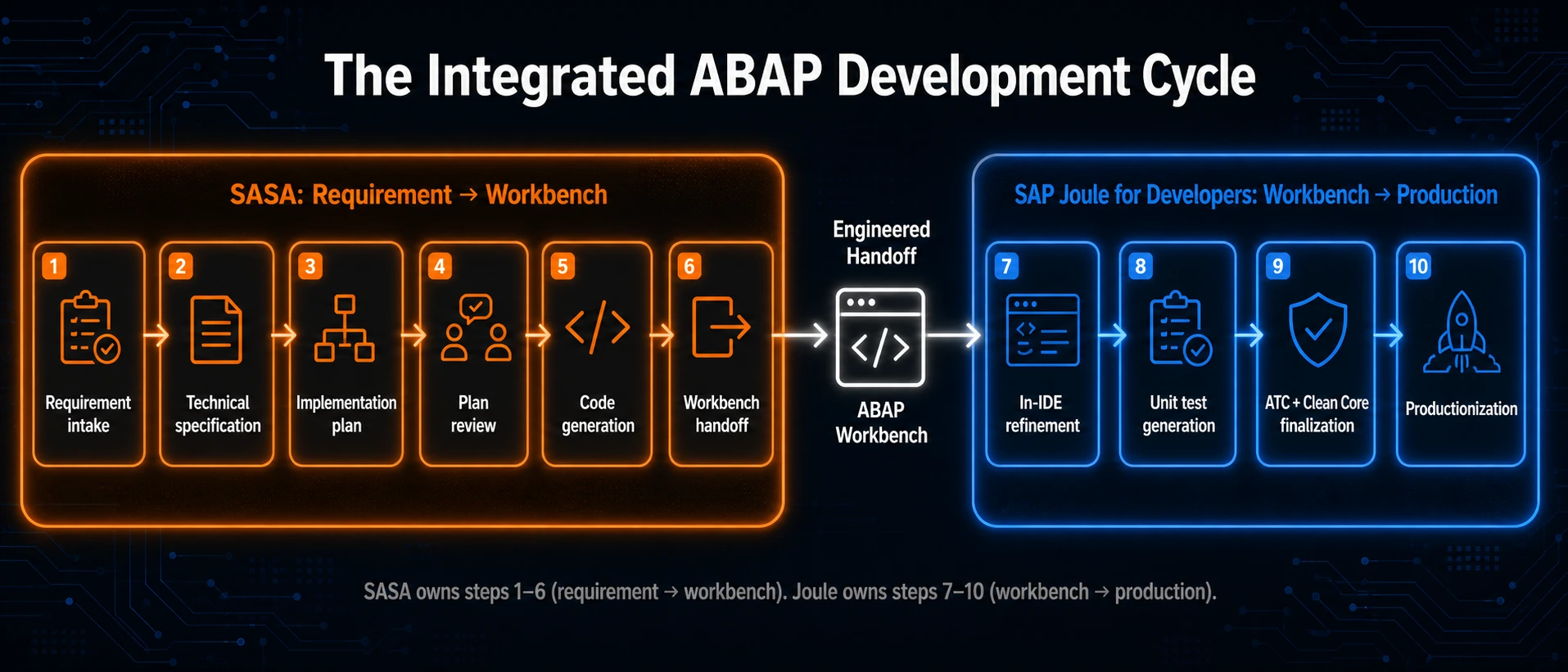
A 10-step integrated workflow
| # | Stage | What SASA Handles | What Joule for Developers Handles |
|---|---|---|---|
| 1 | Requirement intake | Receives the functional spec or business requirement. | — |
| 2 | Technical specification | Generates a technical spec grounded in SAP business context via built-in MCPs (custom tables, BAPIs, organizational rules). | — |
| 3 | Implementation plan | Proposes the implementation plan: class structures, CDS views, RAP services, expected ATC outcomes. | — |
| 4 | Plan review | Developer reviews and refines the plan. SASA records every approval, modification, and rejection for the audit trail. | — |
| 5 | Code generation | Generates production-shaped ABAP and CDS, with Clean Core checks applied before output leaves the platform. | — |
| 6 | Workbench handoff | Pushes generated code into the ABAP workbench / transport layer with full provenance. | — |
| 7 | In-IDE refinement | — | Inside ADT, Joule supports completion, code explanation, and optimization on the new artifact. |
| 8 | Unit test generation | — | Joule generates unit tests for public, protected, and private methods on the new global classes. |
| 9 | ATC + Clean Core finalization | Re-runs Clean Core checks on the post-refinement state. | Joule validates against SAP standards and the ABAP language version of each object. |
| 10 | Productionization | Surfaces program-level visibility and audit-ready evidence end to end. | Completes deployment-ready output for transport release. |
Why ~50% becomes plausible with this integration
Alok Kumar's recent post on this topic is worth reading: he's clear that no single tool gets to 50%, and the practitioner numbers above bear that out. Where the picture changes is when the generation half and the refinement half are integrated rather than assembled. Rough math:
| Configuration | Realistic Productivity | Why |
|---|---|---|
| SAP Joule for Developers alone | ~5% | Refinement gains in the IDE; no change to how requirements become code. |
| Cline + DIY MCPs | ~10–15% | Real agentic generation, but assembly cost and limited governance dampen program-level impact. |
| SASA alone | ~25–30% | Agentic generation with SAP-aware MCPs and Clean Core enforcement built in. Refinement still happens manually. |
| SASA + Joule, integrated | ~50% | Generation gains and refinement gains compound when the handoff is engineered, not improvised. Audit reconstruction and tool-switching overhead largely disappear. |
The reason the integrated pair compounds where assembled stacks tend not to is the handoff. With DIY agentic tooling, developers rebuild context every time generation finishes — there's no clean transport into the workbench, no audit trail to inherit, no Clean Core checkpoint to trust on the way in. With an engineered handoff, the workbench inherits a tracked, Clean-Core-compliant artifact, and the refinement layer's work compounds on top of that instead of competing with it. That's where the program-level gain comes from — and it's why teams investing in this integration are seeing results that meaningfully outpace any single tool.
Where Teams Get Stuck Today
A few patterns we see consistently when SAP teams assemble ABAP AI from generic parts:
- Tool sprawl. Joule for refinement, AWS Accelerator for validation, Cline + DIY MCPs for generation, GitHub for source control. Four to five tools that don't talk, with productivity gains slipping through the seams.
- The governance gap. Audit teams can't easily trace which production lines were AI-assisted, which suggestions were accepted, modified, or rejected. The gap usually surfaces late in the program, when fixing it is expensive.
- Productivity that doesn't compound. A 5% gain in refinement and a 15% gain in generation don't add up to 20% at the program level when the tools aren't connected. The gains stay local.
- The Clean Core plateau. Generated code lands at 20–40% Clean Core compliance with most generic tools, and there's no clear path to push that number higher without a layer that enforces compliance before output rather than after.
- The demo-to-deployment gap. Tools demo on toy ABAP. The same tools, applied to a 30-year-old ECC custom code base, surface every limitation at once. The pilot tends to look great; the rollout doesn't.
Each of these is a coordination problem more than a tool problem. They tend to ease when the generation half is treated as a single integrated step rather than as a stack — which is the part of the picture we work on.
How AiFA Labs Thinks About the Decision
Most of the ABAP AI conversations we have with SAP teams start with a tool question — "should we use Cline or AWS Accelerator or…" — and end up shifting to a workflow question. Once the conversation is about workflow, the decision tends to simplify in two ways.
First, Joule is almost always the right answer for the in-IDE refinement layer. It's free through September 2026, it's SAP-native, it's already where developers are working. We rarely recommend replacing it.
Second, the generation half — turning requirements into code — is where teams have the most options and the least clarity. Cline + DIY MCPs is a strong pattern if the team wants to invest in building and maintaining it. AWS Accelerator fits cleanly for AWS-centric estates. The Microsoft SDK is a different category. SASA is what we built for teams who want the agentic pattern productized: SAP-aware MCPs included, Clean Core enforcement upfront, audit trail by default, and a clean handoff into the ABAP workbench where Joule takes over.
None of these is the only right answer. The point is that the decision becomes more tractable once the generation and refinement halves are evaluated separately.
Where SASA Fits in the Stack
Five things SASA is designed to do, mostly in service of making the requirement-to-workbench half of the cycle feel like a single step:
SAP-aware MCPs included
SASA ships with the SAP-specific MCP layer that DIY agentic setups otherwise require teams to construct. SAP context grounds every generation from the start.
Requirement-to-workbench scope
SASA generates technical specs, proposes implementation plans, produces ABAP and CDS, and pushes the result into the ABAP workbench with full provenance. The reason this matters: the practitioner numbers say the largest gains are upstream of the IDE, not inside it.

Audit-ready by design
Every AI-assisted change is logged with which tool produced it, which suggestions were accepted, modified, or rejected, who approved the plan, and which Clean Core checks passed. This is the layer most generic coding tools don't produce.

Clean Core enforced before output
Compliance is treated as a generation constraint, not a downstream check. The 20–40% first-pass plateau most teams see with generic tools tends to lift when the constraint is applied earlier.

Engineered handoff to SAP Joule for Developers
SASA pushes its output into the ABAP workbench with metadata Joule can pick up natively. Developers open the new artifact in ADT for Eclipse and the refinement layer takes over with no context-rebuilding tax. That handoff is the part of the workflow that makes the ~50% number plausible.
Recommended Next Steps
Three suggestions for Q2 2026, regardless of which generation platform a team chooses:
- Adopt SAP Joule for Developers in ADT for Eclipse now, while the free promotional period continues through September 2026. It's the right refinement layer for almost every SAP team this year.
- Treat the generation decision separately from the IDE decision. They're different jobs and benefit from different tools. Most ABAP AI evaluations get harder when those two halves are bundled into one procurement.
- Pilot the integration, not the components. Whichever generation tool you pick — Cline + MCPs, AWS Accelerator, SASA, or something else — the productivity story depends on how cleanly the output reaches the workbench and how Joule picks it up. Pilot the handoff, not the demo.
If you'd like to talk through any of this
We'd be glad to walk through how SASA and Joule run together against an actual ABAP estate, or just trade notes on the workflow patterns above. Either is fine. aifalabs.com/cerebro/sap-ai-code-assistant has the basics, or get in touch via AiFA Labs.
TL;DR
- Vendor productivity claims tend to outrun reality. Practitioner numbers: ~5% from Joule alone, ~10–15% from Cline + DIY MCPs.
- There are six tool categories most SAP teams evaluate, plus the productized SAP-native generation pattern (where SASA sits). Each fits a different shape of work.
- The workflow that's starting to hold together splits the cycle in two: a generation tool owns requirement-to-workbench, and SAP Joule for Developers owns workbench-to-production.
- ~50% program-level productivity becomes plausible when the two halves are integrated rather than assembled — through a clean handoff, an inherited audit trail, and Clean Core enforced upfront.
- The largest gains are upstream of the IDE, not inside it. That's why the generation decision matters more than most ABAP AI evaluations treat it.
- ABAP developers don't lose jobs in 2026. Workflows that don't coordinate AI tooling tend to lose program velocity, and a fair amount of audit confidence along with it.
References
- SAP Community: Our 2026 Roadmap for Joule for Developers, ABAP AI Capabilities
- SAP Community: Introducing the Next Era of ABAP Development
- SAP: Joule for Developers product page
- AWS: Introducing ABAP Accelerator for AI-Assisted Development
- Precisely / ASUG: New Research Reveals SAP S/4HANA Migration Momentum Despite Ongoing Automation Challenges
- SAPinsider: The New Mandate for SAP S/4HANA Value Realization in 2026
- Devraj Bardhan & Alok Kumar (SAP AI Masterclass Series, Episode 4): How AI Is Changing SAP ABAP Development Right Now — practitioner-reported productivity numbers and the Prompt + MCP + LLM framework.
Frequently Asked Questions
Why does the workflow split between SASA and SAP Joule for Developers?
Because they're built for different parts of the cycle. SASA is designed to take a requirement and produce production-shaped code in the workbench, including the upstream work of generating specs and plans. Joule is designed for the moment a developer is reviewing, refining, and finalizing code inside ADT for Eclipse. The two scopes don't really overlap, which is why the integration is straightforward and why most teams using both end up keeping both.
How realistic is the ~50% productivity number?
It assumes integration, not isolation. Joule alone is roughly 5%, Cline + DIY MCPs roughly 10–15%, SASA on its own sits in the 25–30% range. The ~50% figure applies specifically to a SASA + Joule pair where the handoff is engineered — the developer doesn't rebuild context, the audit trail is inherited, Clean Core checks are enforced upfront. None of those gains require either tool to be faster in isolation; the gain is in eliminating duplication and rework between them.
What is an MCP and why does it matter?
An MCP (Model Context Protocol) is a connector that feeds domain-specific context — SAP business rules, custom tables, BAPIs, organizational policies — into the LLM. Without it, AI tools tend to hallucinate on SAP-specific patterns. With it, output becomes shippable. The formula now consensus among practitioners: Prompt + MCP + LLM = Usable Output. Some tools ship MCPs, some require teams to build their own; that's one of the larger differentiators in the category.
Does adopting SASA mean leaving ADT for Eclipse?
No. SASA does its work upstream of the IDE — generating technical specs, proposing implementation plans, producing code, and pushing into the ABAP workbench. Developers continue working in ADT with Joule as the refinement layer. The IDE experience doesn't change; what changes is what arrives in the workbench, and how the audit trail looks at the end.
Why is Clean Core compliance higher when enforced upfront?
Because most first-pass AI-generated ABAP doesn't follow Clean Core standards out of the box; the 20–40% pass rate teams see is the result. When compliance is treated as a generation constraint — applied before output leaves the platform — the pass rate tends to climb meaningfully, and refinement work focuses on optimization rather than salvage.
When will SAP's own ABAP MCP be generally available?
SAP has scheduled general availability for ABAP MCP and the ABAP Cloud Extension for VS Code in Q2 2026. Once it ships, it will provide a SAP-native agentic environment inside VS Code. It doesn't, on its own, ship customer-specific MCPs configured for a given business context, or audit-ready governance across workstreams — those are areas teams typically still need to address. SASA is built to operate alongside ABAP MCP when it arrives, not against it.
Will AI replace ABAP developers?
Not based on what the data is showing. The shift looks more like a change in workflow than a change in headcount: developers move from writing boilerplate to reviewing AI-generated specs and plans, refining outputs, and validating against business requirements. The honest version of the takeaway is that ABAP developers don't lose jobs, but teams that don't coordinate their AI tooling tend to lose program velocity to teams that do.


