.svg)

Agentic AI is changing how enterprises think about automation, but it is not the right fit for every workflow. Traditional automation and RPA remain effective for stable, repetitive, rules-based tasks, while agentic AI is better suited for multi-step workflows that require context, reasoning, and controlled decision-making. For CIOs and transformation leaders, the real issue is enterprise AI readiness: whether the organization has the process maturity, data quality, integrations, governance, and auditability needed to delegate work safely. This article compares agentic AI vs RPA, explains where traditional automation still fits, and outlines how enterprises can move from automation to governed autonomy with the right enterprise AI service partner.

Why Enterprise Leaders Are Re-evaluating Automation Now
RPA, workflow automation, and rules-based systems still help enterprises remove friction, reduce manual work, and improve consistency across repeatable processes.

What has changed is the type of work enterprises are trying to delegate.
Many operational bottlenecks are no longer simple task-execution problems. They involve context, judgment, changing data, cross-system coordination, and decisions that depend on what happened before and what should happen next.
That is where agentic AI changes the conversation. It does not simply make automation faster. It expands what automation can support, from predefined task execution to controlled, goal-driven action across enterprise workflows.
For CIOs and transformation leaders, the question is no longer just, "What can we automate?" The better question is, "What can we safely delegate?"
What Is Agentic AI?
Agentic AI is goal-driven artificial intelligence that can perform tasks across systems while operating inside clear enterprise controls for access, visibility, auditability, and escalation.
Unlike traditional automation, which follows predefined rules, agentic AI can adapt to context. It can use large language models, natural language processing, enterprise data, external tools, and AI models to determine what should happen next.
In practical terms, agentic AI works by taking a goal, breaking it into steps, gathering relevant information, and deciding how to move forward. Depending on the level of authority granted, it may recommend an action, draft a response, trigger a workflow, update a system, escalate an issue, or complete a task.
That last point is what separates agentic AI from a smarter automation tool. Autonomy without governance creates risk. Governed autonomy creates operational leverage.
Agentic AI vs RPA: Where Traditional Automation Ends and Decision-Making Begins
Traditional automation is not outdated. RPA, or Robotic Process Automation, workflow automation, and rules-based systems still work well when a process is stable, repeatable, and clearly defined.
These tools are useful for invoice routing, basic approvals, data entry, status notifications, form processing, scheduled reporting, document routing, and simple ticket categorization. In these cases, the enterprise needs speed, consistency, and reliability, not independent reasoning.
The limitation is context.
Traditional automation can repeat steps, but it struggles when inputs are unclear, exceptions become common, or the workflow requires judgment. It may route a customer service ticket based on a category, but it cannot reliably understand the full issue, check account history, compare similar cases, and recommend the next best action.
That is where agentic AI changes the operating model.
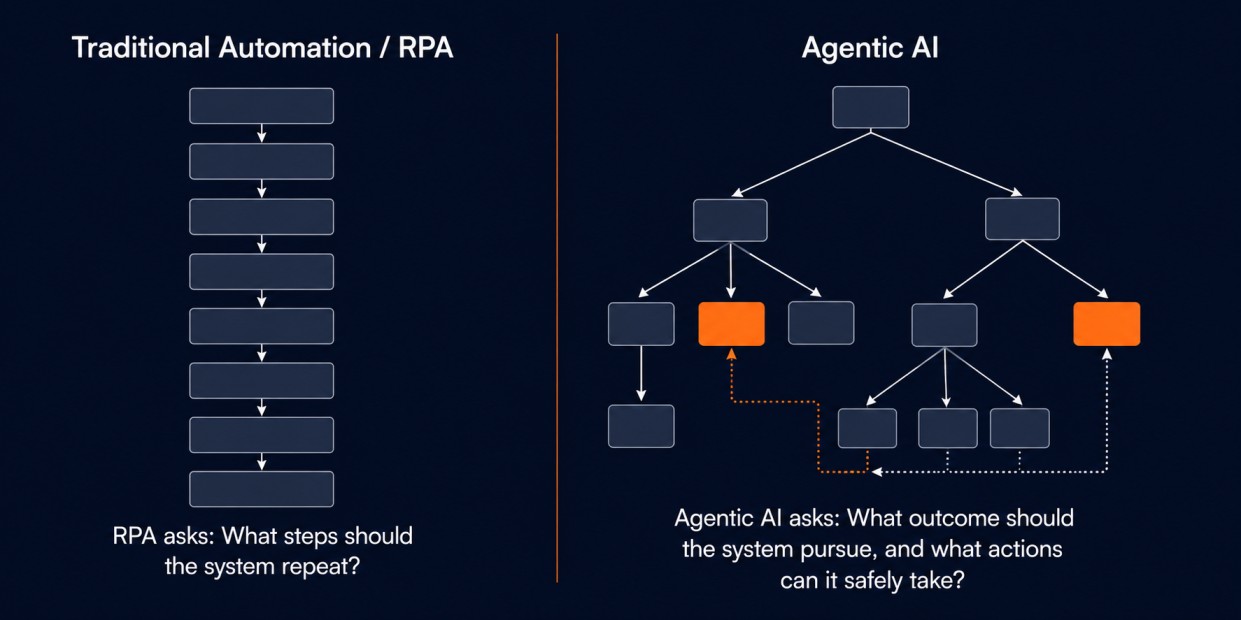
RPA asks: What steps should the system repeat?
Agentic AI asks: What outcome should the system pursue, and what actions can it safely take?
This does not make agentic AI automatically better. It makes it better suited to different problems.
If the enterprise needs to automate repetitive work, traditional automation or RPA may be enough. If it needs to coordinate actions across systems, interpret changing conditions, and support decisions, agentic AI may be the better fit.
The key is not replacing every automation program with agentic AI. The key is knowing which workflows require repetition and which require judgment.
The Value of Agentic AI Is Operational Leverage
The value of agentic AI is often reduced to cost savings or fewer manual tasks. That is too narrow for the enterprise.
The stronger value is operational leverage.
Agentic AI can reduce the distance between signal, decision, and action. It can help teams move from detection to diagnosis faster. It can reduce the coordination burden that sits between departments, systems, and decision-makers.
In many enterprise workflows, the work itself is not the main obstacle. The handoffs are. The waiting is. The repeated search for context is. The manual checking across disconnected systems is.
Agentic AI helps reduce that drag.
In IT operations, for example, an agentic AI system could analyze an alert, check system logs, review past incidents, identify likely causes, and recommend a remediation path. In lower-risk cases, it may perform defined actions. In higher-risk cases, it should escalate the decision.
The goal is not to remove people from the process. The goal is to give skilled teams better context, faster options, and more time for judgment, strategy, and exceptions.
The Enterprise Readiness Question Most Leaders Skip
Many organizations evaluate agentic AI by asking what the technology can do.
That may reveal readiness gaps, but it does not solve them.
The better starting point is this:
What can the organization safely delegate?
Enterprise AI readiness requires more than access to AI models or a vendor platform. It requires clarity around process ownership, data quality, permissions, integrations, governance, security, and risk.
Before deploying agentic AI, leaders need to understand where decisions happen, which data sources are reliable, what systems the AI can access, and who owns the outcome when the AI recommends or takes action.
The enterprise also needs to define levels of autonomy.

Some workflows may allow AI to act with minimal review. Others may require approval before action. Some may only be suitable for AI assistance, not AI execution.
This is where many enterprise AI initiatives lose momentum. The technology may be capable, but the organization is not ready to operationalize it.
The biggest risk is not that agentic AI fails. The bigger risk is that it works well enough to be trusted before the enterprise has the controls to manage it.
That does not mean the enterprise should wait. It means it should start with the right use cases.
Five Readiness Layers Before Moving From Automation to Agentic AI
Agentic AI should not be evaluated only as a technology purchase. It should be evaluated as an operating model change.
Five readiness layers matter.

 1. Process Readiness
The enterprise needs to understand the workflow before it delegates the workflow to AI.
Which steps are repetitive? Which require judgment? Which are unnecessary? Which are undocumented? Which depend on informal knowledge inside specific teams?
If the process is unclear, agentic AI will not fix it. It may simply accelerate the confusion.
Process readiness comes first because autonomy needs structure. The enterprise should not use agentic AI to cover weak operations. It should use agentic AI where workflows are mature enough to be understood, measured, and improved.
 2. Data Readiness
Agentic AI depends on context. Context depends on data.
If the system works from incomplete, outdated, duplicated, or conflicting data sources, the quality of its recommendations will suffer. Worse, it may act confidently on unreliable information.
Enterprise leaders need to know whether the right data is available, whether it is current, and whether the system can access it securely. For workflows that depend on fast decisions, real time data may also be required.
Weak data rarely stops an AI demo. It usually stops deployment.
 3. Governance Readiness
Governance is not a disclaimer. It is the structure that makes agentic AI usable.
The organization needs to define what the system can do, what it cannot do, when approval is required, and when escalation is mandatory.
Different workflows carry different levels of risk. A low-risk internal update does not need the same controls as a customer-facing, financial, legal, or operational decision.
Governance turns autonomy into something the enterprise can trust.
 4. Integration Readiness
Agentic AI becomes operationally useful when it can connect to the systems where work happens.
That may include CRM, ERP, ITSM, ticketing systems, customer service platforms, knowledge bases, communication tools, analytics platforms, or internal databases.
If the system cannot connect to those tools, it may still provide recommendations. But it will not fully perform tasks across the enterprise workflow.
This is where an enterprise AI service partner can help assess what should connect, what should remain isolated, and which integrations are required for a controlled pilot.
 5. Trust and Audit Readiness
Enterprise teams need to see what the AI did, why it did it, and what happened next.
Trust depends on visibility. Leaders need logs, decision trails, performance monitoring, exception reporting, and review mechanisms.
Auditability also supports continuous improvement. As AI agents learn from outcomes, the enterprise needs a way to confirm that performance is improving in the right direction.
Without auditability, adoption will stall. Teams will not trust systems they cannot inspect.
A Better Adoption Path: Automate, Assist, Then Agentify
Agentic AI should not be treated as a switch. It should be treated as an enterprise maturity curve.
A practical path has three stages.

First, automate the predictable. Use traditional automation for repetitive, stable workflows where the rules are clear and the risk is low.
Second, add AI assistance. Use generative AI, natural language processing, and AI-powered tools to summarize information, classify requests, prioritize work, draft responses, and support human decisions.
Third, introduce supervised agentic AI. Allow agentic AI systems to perform multi-step work with approval checkpoints, defined permissions, and clear escalation rules.
Autonomy should expand only after trust is proven.
This is where an enterprise AI service can create value. The right partner can help identify suitable use cases, assess enterprise AI readiness, map integrations, define governance, and move from controlled pilots to operational deployment.
The goal is not to force agentic AI into every workflow. The goal is to identify where it creates measurable business value without creating unnecessary risk.
From Automation to Governed Autonomy: How AiFA Labs Helps Enterprises Get There
The decision between traditional automation, RPA, and agentic AI is not always obvious. Some workflows are ready for more autonomy. Others are not. The risk comes from treating them the same.
AiFA Labs helps enterprises separate the right opportunities from the wrong ones before they invest too heavily, move too quickly, or connect AI to systems that are not ready for it.
The process starts with a readiness assessment. AiFA Labs reviews the workflows, data, integrations, decision points, and risk areas to identify three things: where agentic AI can create value now, where traditional automation still makes more sense, and where the enterprise needs to strengthen the foundation first.
From there, AiFA Labs helps turn the strongest use cases into controlled pilots. That means clear approval paths, defined autonomy levels, audit trails, success criteria, and a practical plan for what happens after the pilot.
The goal is simple: help the enterprise move toward agentic AI without turning it into another disconnected AI experiment.
Done well, agentic AI becomes something the business can understand, govern, measure, and trust.
To explore where agentic AI fits in your enterprise, start with an AiFA Labs readiness assessment.
TL;DR: Which One Is Your Enterprise Ready For?
Agentic AI and traditional automation solve different problems.
If the workflow is stable, repetitive, rules-based, and low-risk, traditional automation or RPA is likely the better fit.
If the workflow is multi-step, context-heavy, dependent on changing information, and requires decision support, agentic AI may be the better fit.
For CIOs, Chief Digital Officers, and transformation leaders, the decision should not start with which technology is more advanced. It should start with enterprise AI readiness.
The enterprise needs process maturity, reliable data, clear governance, secure integrations, and auditability before greater autonomy can scale safely.
The right path is deliberate: automate where the process is predictable, assist where human judgment still leads, and agentify where the enterprise is ready for controlled autonomy.
References
- Google Cloud — AI Agents and Enterprise AI Solutions
- Google Cloud — Vertex AI Agent Builder
- Microsoft Learn — Design Autonomous Agent Capabilities in Copilot Studio
- Microsoft Learn — Responsible AI Principles and Approach
- NIST AI Risk Management Framework
- NIST Artificial Intelligence Risk Management Framework: Generative AI Profile
- ISO/IEC 42001:2023 — Artificial Intelligence Management System
- IBM — What Are AI Agents?
- AWS — What Are AI Agents?

FAQ


