.svg)

ECC-to-S/4HANA, PI/PO-to-BTP, and day-to-day AMS have all gone AI-led — and they should have; it is how the SAP base reaches a closing window. But AI is no longer just accelerating the work. It is authoring the core you will run for the next decade. Here is what that quietly changes, why 2027 turns it urgent, and how the record you keep while you build — without slowing a thing down — becomes the track record that lets your AI run with less review after go-live.

Key Takeaways
- AI now writes much of the migration — the ABAP, the tests, the mappings, the iFlows. With ECC and PI/PO maintenance both ending in 2027, that isn’t a shortcut; it’s the only way the remaining wave makes the window.
- Three clocks strike 2027 at once: ECC end of maintenance, PI/PO end of maintenance, and the EU AI Act’s high-risk rules (2 December). Your migration goes live the same quarter the AI rulebook switches on.
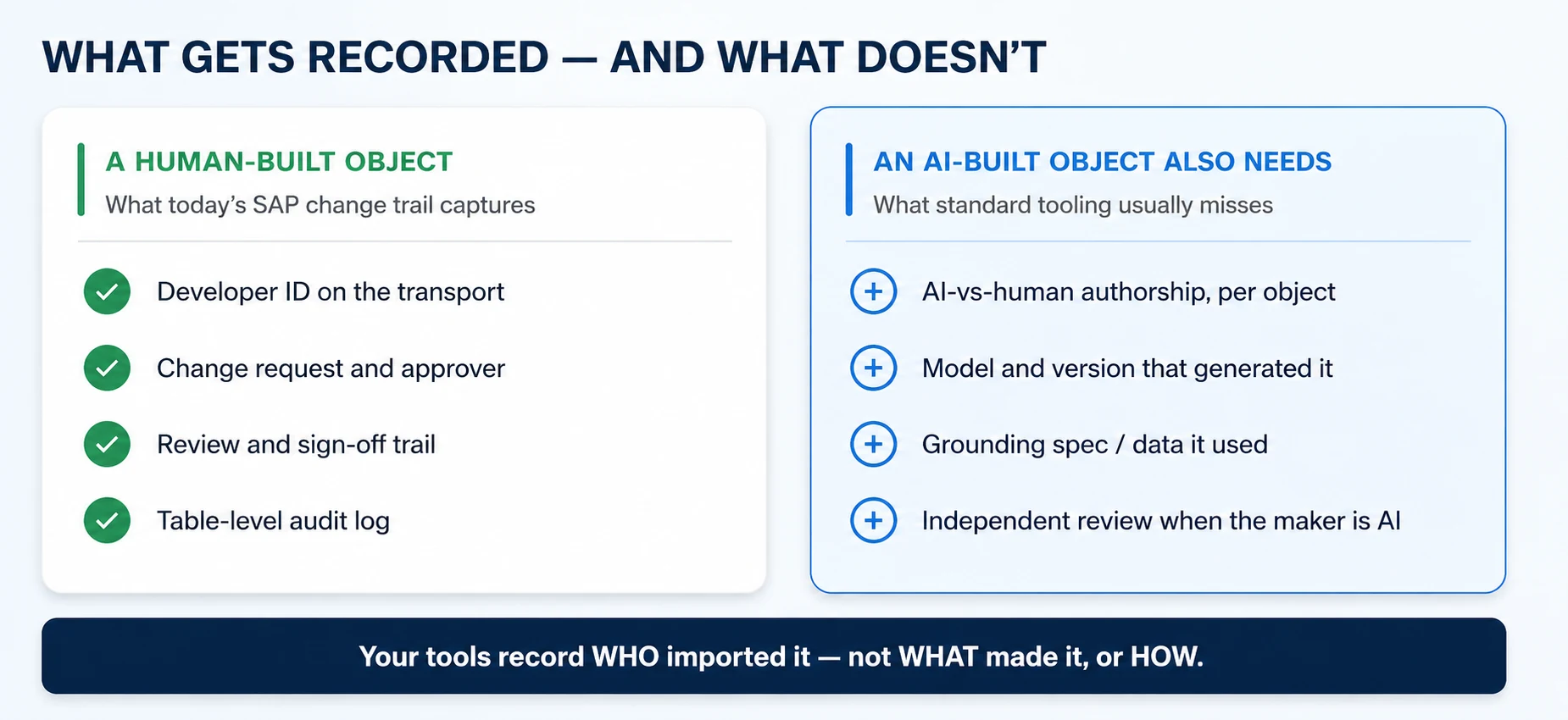
- Provenance — which objects are AI-made, on what model and spec, reviewed by whom — has to be captured during the build. It is what validation (GxP), SOX, and your auditors ask for; it becomes the core you run for a decade; and you can’t reconstruct it after cutover.
- The payoff isn’t the audit binder. Provenance plus instant rollback on every AI change is the track record that lets your agents earn autonomy in AMS and the next wave — so human review falls as trust grows, and compliance comes along as the byproduct.
The delivery is already AI’s job
Walk a live SAP program today and the building is already being done by machines. Custom ABAP — analyzed, remediated, and converted by SAP’s own ABAP-AI: Joule for Developers, the Mass Custom Code Conversion Agent, the ABAP Accelerator. Test suites — written from the spec. Data objects and reconciliations — drafted by agents. On the integration side, SAP’s tooling auto-converts an estimated 60–70% of the move from PI/PO to Integration Suite on BTP.
This is not corner-cutting. It is arithmetic. ECC mainstream maintenance ends on 31 December 2027, most of the base has yet to move, and a full migration runs 18 to 36 months. There is no human-only path to that finish line. SAP is right to power AI-led delivery, and the partners and AMS teams adopting it are right to use it. The speed is real, and so is the saving. The side effect is what no one has priced in.
The convergence no one put on the plan
Every prior SAP upgrade was a project. This one is a collision. Three deadlines, unrelated to one another, land on the same programs in the same year: ECC maintenance ends in 2027, PI/PO maintenance ends in 2027, and on 2 December 2027 the EU AI Act’s high-risk obligations — automatic logging under Article 12, human oversight under Article 14 — take effect.
Read that with your project calendar open. The first two clocks force the migration — no maintenance, no choice. The third raises the bar the result is held to: from December 2027, AI that performs high-risk functions must log what it does and stay under human control. Your ERP core and your integration backbone go live in the same quarter that standard takes effect — same systems, same teams, same months. That intersection is not a workstream on anyone’s plan. It should be.
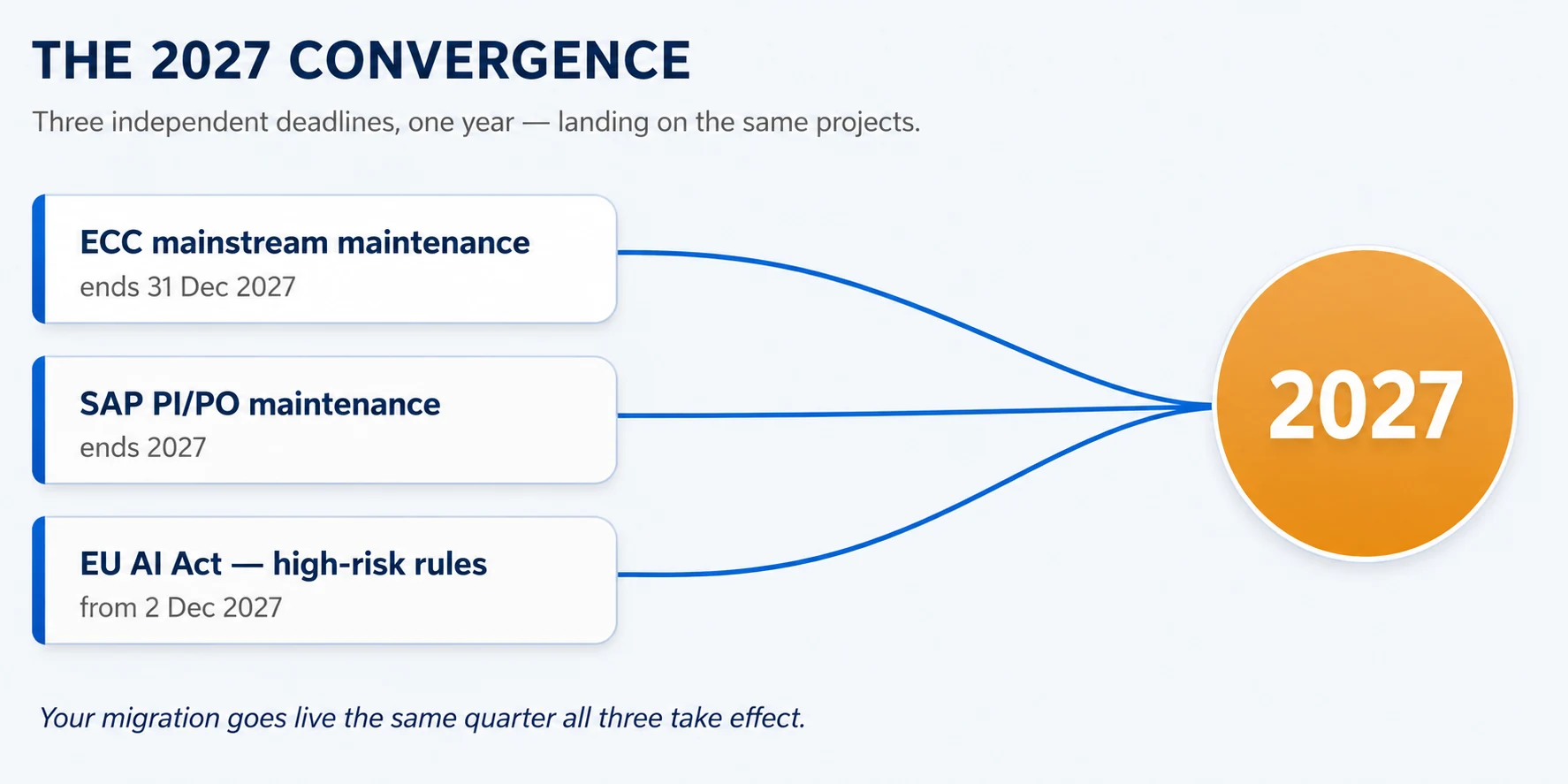
AI isn’t just accelerating your migration. It’s authoring your next core — and right now, that core has no memory of how it was written.
What changes when machines do the building
Proven in production — 100+ SAP AI agents. AiFA Labs has delivered AI agents across a global pharmaceutical leader and Fortune 200 enterprises — running in production, inside the customer’s firewall, in GxP-validated environments.
A human consultant leaves fingerprints: a name on the object, a transport, a review, a hallway conversation someone still remembers. An agent leaves none of that. It produces the same ABAP, the same mapping, the same iFlow in seconds — and unless you capture it on purpose, nothing records which objects were machine-made, which model and version made them, what spec or data they were built from, or who looked before they shipped.
Multiply that by the tens of thousands of objects in a migration and you arrive somewhere strange: a brand-new core, running the company, with no memory of how it was made. On go-live day it works, and the gap is invisible. It turns visible the first time someone has to explain, defend, or revalidate what the system actually does — and by then the context, and the people, are long gone.
Why regulated and financial cores feel it first
For a warehouse report, missing provenance is a maintenance headache. For a validated or financial system, it is a finding — and SAP’s largest customers live in exactly those systems. These are the rules that bite a delivery team directly, today, long before the AI Act enters the picture.
Life sciences. A GxP-relevant SAP system has to be validated, documented, and audit-ready. GAMP 5’s second edition — Appendix D11 now covers AI/ML — and the 2025 ISPE GAMP Guide: Artificial Intelligence push ALCOA+ data integrity, model and version control, and audit trails onto AI-built artifacts. An object that entered a validated system with no record of how it was generated or reviewed is not a gray area; it is the line an inspector circles, and it can put the validated status of the whole system in doubt.
Finance. Your new S/4HANA finance core, and every integration feeding it, is SOX territory. Change evidence and separation of duties apply to a machine’s changes as much as a person’s — which raises a question most change boards have never faced: what happens when the maker and the approver are both AI?
Everything high-risk — stated precisely, because it is widely overstated. Using AI to write your migration does not, by itself, put your team under the EU AI Act. But where the functionality you deliver is high-risk — AI that screens people, scores credit, or drives safety — Article 12 (logging) and Article 14 (human oversight) become design requirements for that feature from December 2027. Those are systems being built right now.
And it does not stop at go-live. The same story runs straight into AMS, where support agents increasingly close tickets by changing production. Every one of those AI-made changes to a validated or SOX-relevant system needs the same provenance — not once, but every day.
You can’t backfill a build
Here is the part that is easy to push to phase two and impossible to recover later. You migrate your core once in a decade. The provenance you capture during the build is the provenance you keep; everything you skip is gone the day the project team rolls off — the model version, the grounding spec, the reviewer, the reason. There is no retroactive capture. The build is the only window, and it closes on cutover.
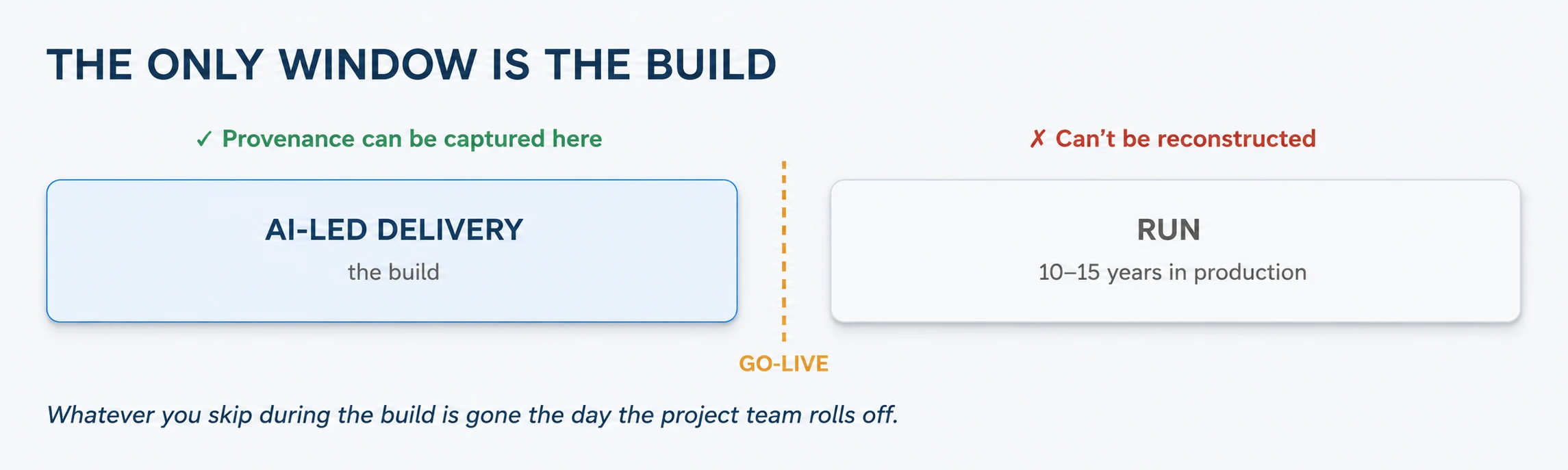
You migrate your core once a decade. Whatever you don’t record while you build, you can’t reconstruct after you go live.
So prepare — without touching the throttle
Preparing for AI-led transformation does not mean slowing the AI down. It means instrumenting it — and the instrument pays twice. The record you capture during the build is the same track record that lets your delivery and AMS agents earn more autonomy after go-live, so the review burden falls as trust grows. Six moves a team can start on the next sprint, not the next program:
- Make provenance a property of the pipeline. Tag every artifact AI-made or human-made; capture the model and version, the spec or data behind it, and the human sign-off — automatically, at the transport and toolchain boundary, the way we do it in our own delivery, so nothing moves to the next system without its record. Minutes, not weeks.
- Treat delivery agents like staff. Each agent gets a scope, an authorization, and a record of what it touched — above all in AMS, where it touches production every day.
- Make every AI change reversible. Pair each AI-made object and each agent change to production with a one-click rollback, so anything a machine does can be undone as fast as it was done. Reversibility is what makes AI speed safe to accept — and it is the cheapest trust you will ever buy.
- Carry the evidence past cutover. Provenance trapped in project tooling dies at go-live. Land it where Quality, Audit, and AMS can query it for the life of the system.
- Map to your frameworks on day one. Line the evidence up with GAMP 5 / CSA, SOX change control, and EU AI Act Articles 12 and 14 at kickoff — not at hypercare, and not in front of an auditor.
- Instrument the wave you’re on. You don’t need a fresh project. Start capturing on the objects still ahead of you; every one is a future you won’t have to defend blind.
The bottom line
AI-led delivery is how the SAP base reaches 2027, and SAP is right to power it. But the speed that gets you to S/4HANA and BTP on time can just as quietly seal a decade of blind spots into your core. Instrument the build, and you keep the speed and land a core you can prove — validation-ready and audit-ready the day it ships, with every AI change reversible and the evidence already in hand for whatever your quality team, your auditors, and the regulators ask next. More valuably, you land the track record that lets the agents running your AMS keep earning autonomy from day one: compliance is the byproduct; the durable win is AI you can trust to run. The window is open now. It closes with the build. Keep the receipts.
Let’s talk — bring us your migration reality
No two SAP landscapes are alike. Tell us where AI is writing your migration, integration, or AMS — and the accountability questions it’s raising — and we’ll come back with a specific, no-obligation read on what to capture and how, for your build. Start the conversation.
About the author
Sagar Chakraborty is Director of Artificial Intelligence Innovations & Strategy at AiFA Labs and one of India's Top 10 AI Leaders (TradeFlock, 2025). He leads the team building SASA — AiFA's AI-powered SAP SDLC platform, validated in a GxP life-sciences production environment. Before AiFA Labs, he shipped AI products at Amazon Robotics and holds active research collaborations with IIT Jodhpur and IIT Kharagpur for Fortune 500 companies. Sagar has a PhD in AI and before AiFA Labs, he shipped AI products at Amazon Robotics, Wipro and BAAR Technologies and holds active research collaborations with IIT Jodhpur and IIT Kharagpur.
Selected sources
- SAP — Process Orchestration to Integration Suite migration (BTP)
- SAP Community — Custom code migration to S/4HANA with Joule for Developers / ABAP AI
- IgniteSAP — The S/4HANA 2027 deadline
- GAMP 5 & AI/ML validation in GxP environments (Appendix D11; ISPE GAMP Guide: AI)
- EU Artificial Intelligence Act — Articles 12 (Record-keeping) and 14 (Human Oversight)


