.svg)

SAP BUSINESS AI · AGENT AUTONOMY
How to let SAP’s AI agents actually run — and why the trust behind autonomy has to start now
SAP has put capable AI agents into every process and given you the Agent Hub to govern them. The next advantage isn’t more agents — it’s trusting the ones you have enough to let them run unsupervised. Here’s how to turn supervised pilots into autonomous throughput, why the foundation compounds (so starting now matters), and how it makes you ready for 2027 almost for free.
KEY TAKEAWAYS
- SAP has made AI agents genuinely capable and given you the SAP AI Agent Hub to inventory and govern them. The next advantage isn’t more agents — it’s trusting the agents you already have enough to let them run unsupervised.
- Today most agents stay supervised, so the speed and savings sit in a review queue. The unlock is earned autonomy: a measurable track record, a clear mandate, a safe place to rehearse, and an undo for everything an agent does — which, alongside the Agent Hub, turns supervised pilots into autonomous throughput.
- Trust is earned from history that can’t be backfilled and takes 18–24 months to build — so the time to start is now. The same foundation makes you ready for the EU AI Act’s 2 December 2027 high-risk deadline almost for free.

The autonomous enterprise has a permission problem, not a capability problem
At SAP Sapphire 2026, the message was clear and credible: the enterprise is becoming autonomous. Joule is now a full agentic platform, SAP ships dozens of prepackaged agents and more than 2,400 Joule Skills, and agents increasingly act as participants in real business processes across the SAP estate and — through open A2A and MCP interfaces — beyond it.
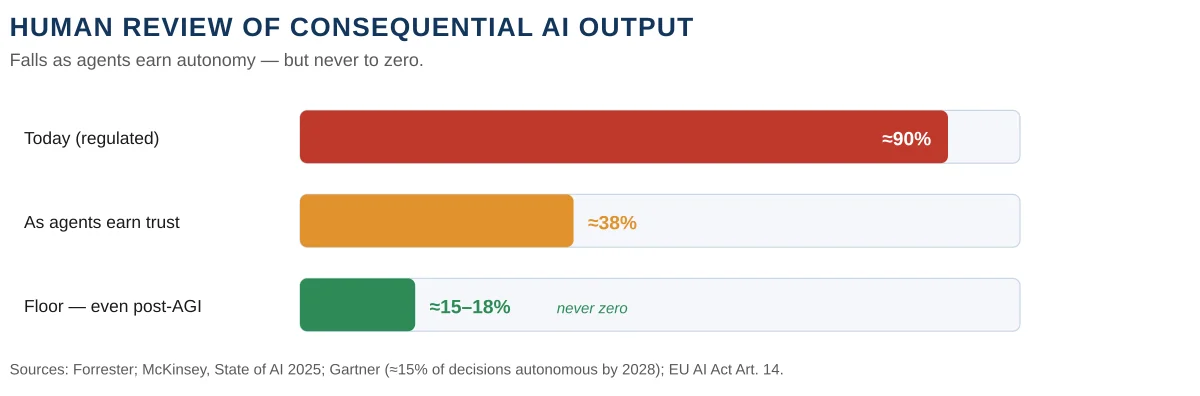
Now walk the floor of almost any enterprise that has deployed them, and you’ll find something curious: the agents are capable, but barely any of them are actually allowed to run. A human still reviews the overwhelming majority of consequential AI output — industry data puts human-in-the-loop adoption near 78%, while inaccuracy remains the single most-cited AI risk. The speed and the savings you invested in are real — but they’re sitting in a review queue.
That is not a capability problem. The models are good enough; SAP has proven it. It is a permission problem. You cannot safely let an agent act on its own if you have no way to know whether it has earned the right — and today, most enterprises have no such measure. So they do the only prudent thing: they supervise everything, and the productivity stays trapped.
Your SAP agents don’t have a capability problem. They have a permission problem — and permission is earned, not bought.
PROVEN IN PRODUCTION
100+ SAP AI agents, in production
Delivered and governed by AiFA Labs across a global pharmaceutical leader and Fortune 200 enterprises — operating inside the customer’s firewall, in GxP-validated environments, under continuous human oversight.
SAP gave you the agents — and the inventory to govern them
SAP has already solved the first half of the equation, and solved it well. Alongside the agents themselves, the SAP AI Agent Hub, delivered within SAP LeanIX, gives you a vendor-agnostic command center: it auto-discovers agents — SAP’s, custom-built, and third-party — captures risk ratings and compliance mappings, governs each agent’s lifecycle from proposed to decommissioned, and publishes approved agents to a governed catalog, at no additional charge within the Business AI platform.
This is exactly the control plane an enterprise needs before it has a hundred agents it can’t name. Think of it as the directory and the rulebook for your digital workforce — the indispensable foundation that everything else is built on. The question it raises is the natural next one: now that you can see and govern your agents, how do you decide which of them you can actually trust to act?
The unlock: turning supervised pilots into trusted operators
Letting an agent run unsupervised is a promotion, and promotions are earned on evidence. Four things turn a capable agent into a trusted one — and together with the Agent Hub, they complete the picture:
A measured track record. Every action an agent takes — the intent, the data it used, the model and version, the human edit, the sign-off, the result — captured as a signed, replayable record. Trust stops being a feeling and becomes a number you can stand behind.
A clear mandate. Who authorized this agent, for what scope, with what limit, until when — readable in one line and revocable in one click. The same delegation discipline you already apply to people.
A place to rehearse. The ability to test a consequential change against a realistic copy of your environment before it touches production — the way pilots earn hours in a simulator, not on the live aircraft.
An undo for everything. Every change an agent makes to any enterprise system is reversible in one click — so the worst case of granting autonomy is never a disaster, only a rollback. Reversibility is what makes the promotion decision safe to take, and it is what turns a cautious pilot into a confident grant.
In our own SAP deployments, that is exactly how we license an agent — a scope, an expiry, a track record, a kill switch, and a one-click undo — so autonomy is granted per task class, never all at once.
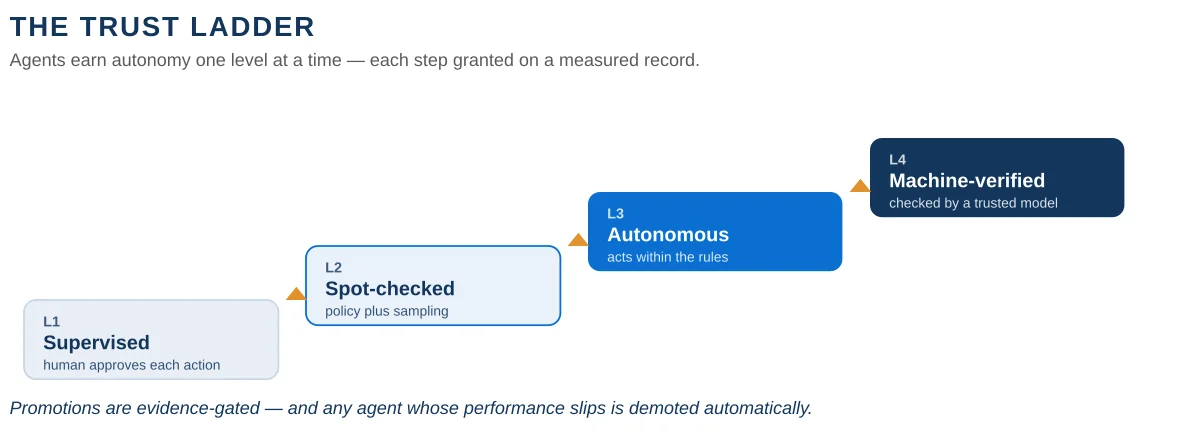
This is where the trapped value is released. Every task an agent earns the right to run unsupervised is review-hours returned to your experts and cycle-time taken out of the process — and it scales precisely as your agent population grows. SAP gives you the workforce and the directory; a measured trust layer is what lets that workforce graduate from supervised to autonomous, safely. The two are not competitors; they are two halves of the same outcome.
Why the foundation has to start now
Here is the part that’s easy to defer and expensive to delay: trust compounds, and it cannot be bought late. A licence to operate backed by 10,000 logged runs is worth more than one backed by 100 — and that history accrues one day at a time. Start building the record now and your agents graduate to autonomy on a schedule you control. Start late and they sit in supervised pilots, capable but caged, while competitors who began earlier are already running whole categories of work hands-free.
Audit and governance probably aren’t at the top of your priority list today — and that is exactly what makes the timing dangerous. The evidence foundation that earns autonomy is the same one regulators will require, and it takes 18–24 months to build and validate. It cannot be created retroactively: you can’t reconstruct, after the fact, a signed record you never kept. So by the time governance feels urgent, the option to have started early is already gone.
The good news is that you never have to build it for the auditor. Build it to set your agents free — to release the trapped productivity — and where those agents touch high-risk decisions, you reach the EU AI Act’s 2 December 2027 deadline (Article 12 logging, Article 14 human oversight) ready almost as a side effect. Compliance becomes the byproduct of chasing value, not a separate cost center.
You won’t build an evidence trail for the auditor. You’ll build it to set your agents free — and pass the 2027 audit for free.
A practical path SAP teams can start now
None of this requires a rip-and-replace or a single vendor. It’s a maturity path that runs alongside the Agent Hub:
- Treat agents as a workforce. Pair identity (the Agent Hub, Entra Agent ID, Okta) with an earned licence (scope and autonomy level) and a mandate — who authorized this agent, for what, until when.
- Capture evidence at the moment of action. Record the signed trail as the work happens, not by scraping logs afterward — so the track records your trust depends on are real and tamper-evident.
- Promote agents on a graduated ladder. Move task classes from supervised to spot-checked to autonomous as each agent earns it, and demote automatically the moment performance slips.
- Spend human review where it changes the outcome. A durable share of consequential work — realistically 15–20% — will stay under human review indefinitely; Gartner expects only about 15% of decisions to be fully autonomous by 2028. Route that scarce attention to the highest-risk cases and batch-approve the safe tail.
- Start with one high-volume process and a 90-day baseline. Measure today’s review load and cycle time first, then release the trapped value — so the ROI is provable from your own records, not asserted from a slide.
The bottom line
SAP has made the autonomous enterprise real in capability and given you the hub to govern it. The companies that pull ahead over the next two years won’t be the ones with the most agents — they’ll be the ones that can trust the agents they have enough to let them run. Pair SAP’s agents and Agent Hub with a measured trust layer, and supervised pilots become autonomous throughput; the productivity you’ve already paid for comes off the bench; and you walk into 2027 ready. The foundation compounds, and it can’t be backfilled — so the only real question is when your counters start.
LET’S TALK — BRING US YOUR HARDEST ONE
Every agent estate is different. Tell us which agents you’re running and exactly where trust breaks down — and we’ll come back with a specific, no-obligation read on the path to safe autonomy for your landscape. Start the conversation: aifalabs.com/free-demo.
About the author
Sagar Chakraborty is Director of Artificial Intelligence Innovations & Strategy at AiFA Labs and one of India's Top 10 AI Leaders (TradeFlock, 2025). He leads the team building SASA — AiFA's AI-powered SAP SDLC platform, validated in a GxP life-sciences production environment. Sagar has a PhD in AI and before AiFA Labs, he shipped AI products at Amazon Robotics, Wipro and BAAR Technologies, and holds active research collaborations with IIT Jodhpur and IIT Kharagpur for Fortune 500 companies.
Selected sources
- SAP News Center — The Future of the Enterprise Is Autonomous
- SAP Insider — SAP Sapphire 2026: The Autonomous Enterprise and AI Agent Guardrails
- IgniteSAP — SAP AI Agent Hub and Agent Governance
- McKinsey — The State of AI in 2025
- EU Artificial Intelligence Act — Articles 12 (Record-keeping) and 14 (Human Oversight)


