.svg)

SAP API management gives organizations the infrastructure to publish, secure, and monitor APIs across an enterprise landscape. But having that infrastructure running is not the same as having a strategy. This article covers the governance gap that most SAP teams never close, including why SAP API development defaults to duplication, what a layered API architecture actually requires, and how lifecycle management failures create long-term risk. It is written for SAP architects, integration leads, and IT managers who are responsible for how APIs are built and maintained across the organization, not just whether they work today.

TL;DR
- SAP API Management handles the operational layer. Governance (ownership, standards, versioning, lifecycle) has to be defined separately.
- Project-driven API development produces duplication, inconsistent naming, and APIs with no clear owner.
- A three-layer architecture (system, process, experience APIs) prevents direct ERP dependencies and creates the conditions for reuse.
- APIs without lifecycle governance stay running indefinitely, accumulating risk with no clear path to retirement.
- Fixing a governance gap starts with a catalogue of what exists, then moves to standards, ownership, versioning policy, and deprecation process, in that order.
Why Most SAP Teams Think They Have an API Strategy When They Don't
SAP already provides strong API capabilities. Through SAP Integration Suite, organizations can publish APIs with OAuth authentication, apply rate limiting, monitor usage, configure mediation policies, onboard developers through a portal, and manage the API lifecycle end to end. For many teams, getting all of that in place feels like the job is done.
The gap is not in the tooling. It shows up later, when a second team builds a Customer API because they didn't know the first one existed. When a backend system changes, and nobody can identify which APIs depend on it. When a project ends, and the API it produced has no assigned owner. The platform keeps running. The problems accumulate quietly.
What SAP API Management Actually Covers
SAP API Management, delivered as part of SAP Integration Suite, handles the operational layer: who can call an API, how often, under what credentials, and with what level of visibility into traffic and errors. It sits between backend systems and the consumers that need access to them, and it does that job well.
What it does not cover is the decision layer. Which team is responsible for this API after the project closes? Is there already an API that does this? What counts as a breaking change, and who gets notified when one happens? How long does a deprecated endpoint stay live?
Those are policy questions. SAP API Management can enforce policies once they exist, but it has no mechanism for creating them. That part falls entirely on the organization.
The Actual Problem in Most SAP API Development Projects
The default pattern in SAP landscapes is project-driven API development. A CRM integration needs a Customer API, so one gets built. A mobile app needs slightly different data from the same source, so another gets built. A partner portal comes along, and a third version appears. Each team built what they needed, when they needed it, without checking what already existed.
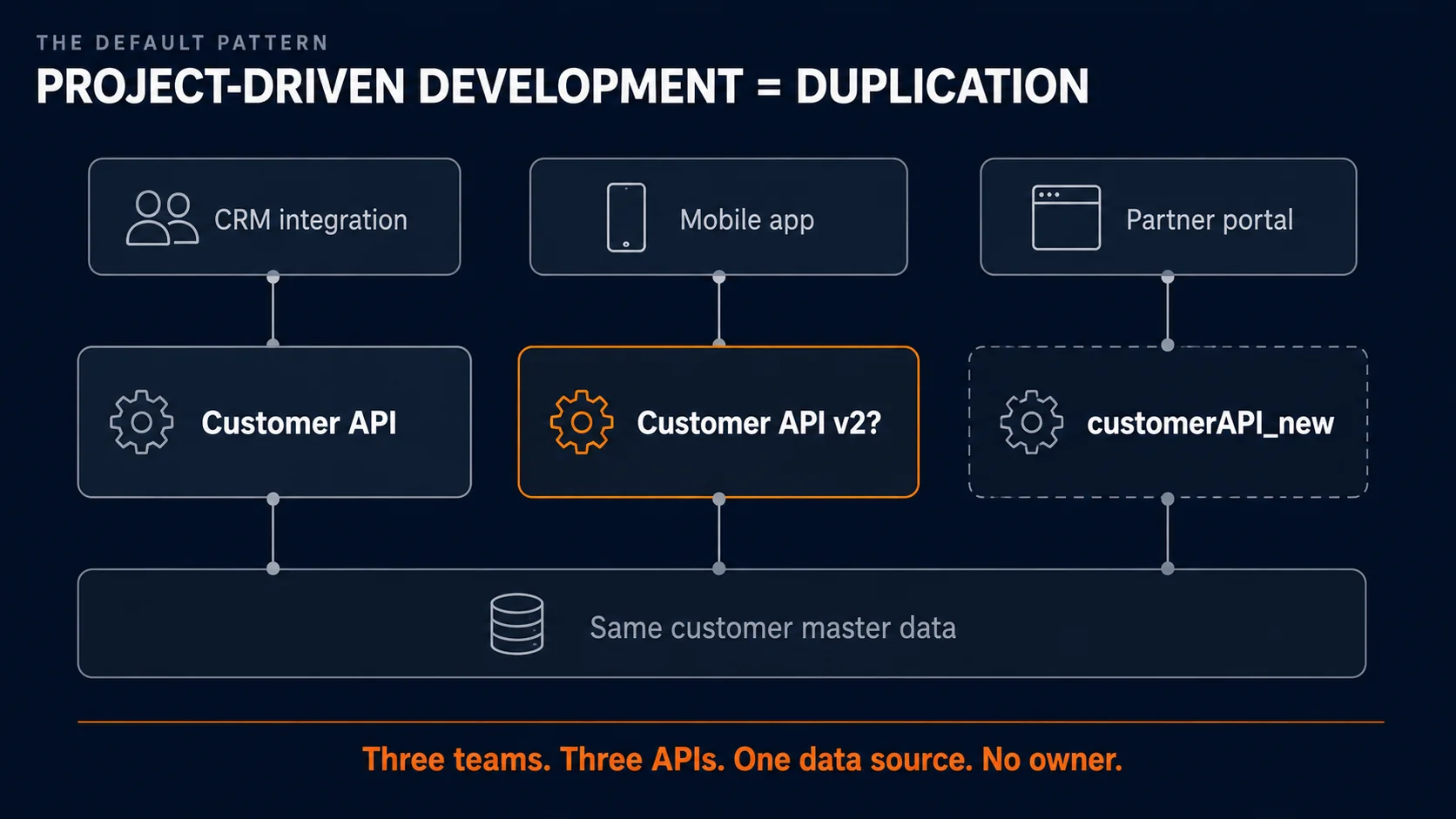
A few years in, the landscape has duplicate APIs with different field structures, different naming conventions, and different authentication methods. Some of them are still receiving traffic from systems nobody has documented. Turning them off feels risky. Updating them is unclear. Nobody knows who to ask.
This is the situation SAP API management was supposed to prevent. It doesn't prevent it on its own, because the problem is not technical — it's that no governance process was defined before development started.
How the Layered API Architecture Fixes the Structural Problem
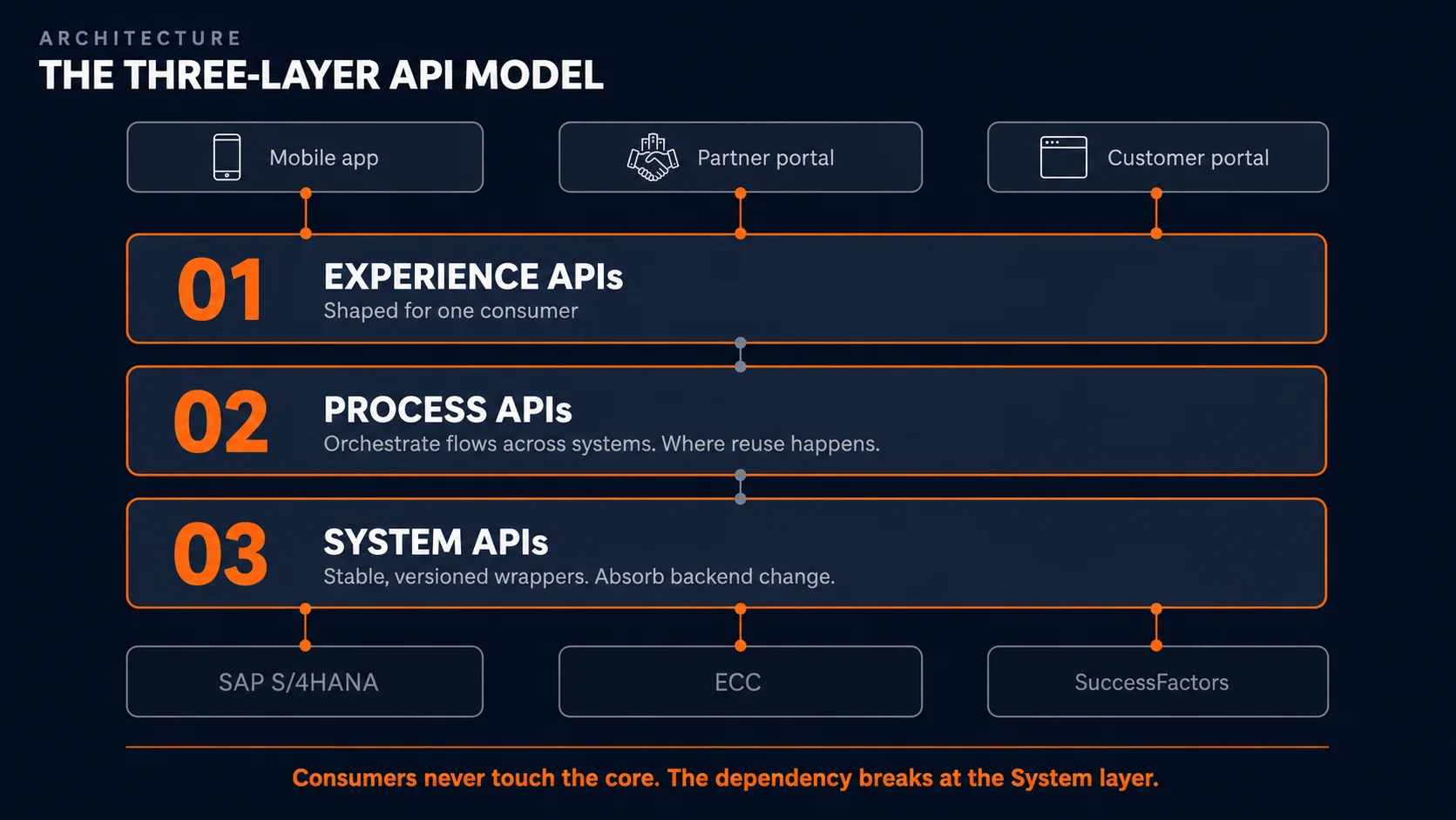
The most widely adopted solution to this is a three-layer API model, popularized by MuleSoft's API-led connectivity approach and applicable directly to SAP environments. The layers create separation of responsibility, so a change in one part of the stack doesn't cascade through everything else.
System APIs
System APIs wrap core backend systems (SAP S/4HANA, ECC, SuccessFactors) in stable, versioned interfaces. Their job is to absorb backend changes. If SAP updates an internal data structure, the system API is the only layer that needs updating. Everything built on top of it keeps working.
Process APIs
Process APIs orchestrate business flows that span multiple systems. An order-to-cash process might pull from SAP, a CRM, and a logistics platform. The process API handles that coordination and holds the business logic. This layer is also where reuse actually happens — one process API can serve multiple downstream consumers.
Experience APIs
Experience APIs are shaped for specific consumers: a mobile app, an external partner, a customer portal. They take output from the process layer and format it for a particular use case. Multiple experience APIs can sit on top of the same process API, each returning only the data structure that the consumer needs.
The practical value of this model is that frontend applications never connect directly to SAP S/4HANA or any other core system. That dependency is broken at the system API layer.
Where This Applies Across Different SAP Environments
The governance gap looks different depending on where an organization is in its SAP journey, but it shows up in most of them.
 S/4HANA migration projects
Migration projects are high-pressure environments where teams build APIs for the integration at hand and move on. Versioning, ownership, and naming standards get deferred because go-live is the priority. The technical debt created in this window is some of the hardest to unwind later.
 Teams already running SAP Integration Suite
If the platform is in place but the governance isn't, the tools are being used as a project utility rather than a strategic layer. The question is not whether SAP API Management is configured correctly; it usually is. The question is whether anyone has defined what happens to the APIs it's managing after the project that created them ends.
 Landscapes mixing SAP and non-SAP systems
The more systems in play, SAP alongside Salesforce, ServiceNow, or custom platforms, the more critical it becomes to have process APIs that orchestrate across them. Without that layer, every cross-system integration becomes its own custom connection, and the API layer provides no actual reuse benefit.
A Concrete Example of What the Governance Gap Costs
Picture this: A mid-size manufacturer runs SAP S/4HANA. Over three years, four separate project teams have built integrations that each required access to customer master data. Each team created their own API. The APIs have different field names for the same data, different authentication setups, and were built to different internal standards, because no standard existed.
When the company decides to build a customer-facing portal, the integration team finds four versions of what is effectively the same API. Two are still live and receiving traffic. Nobody knows from which systems. One is documented. The others are not.
The portal project stalls while the team audits the existing landscape. The work that should have been done at the start of the first project is now being done under pressure, years later, with incomplete information.

A single Customer System API, owned by a named team, with a documented consumer list and versioning policy, would have prevented all of it.
Questions That Should Be Answered Before Any SAP API Goes Into Development
Most API governance failures are traceable to decisions that were never made before the first line of code was written. These questions should have answers before development starts:
- Who owns this API after go-live, including responsibility for changes, incidents, and deprecation?
- Does an API that covers this use case already exist in the catalogue?
- What constitutes a breaking change, and what is the versioning approach when one occurs?
- Which systems and teams are authorized to consume this API?
- How will consumers be notified when the API changes or is deprecated?
- When this API is eventually retired, what is the timeline and the process?
Getting these answers upfront is not bureaucratic overhead. It is the difference between an API catalogue and an API graveyard.
What Happens When API Lifecycle Management Is Left Undefined
APIs built without lifecycle governance tend to stay running long past their intended lifespan. No versioning policy means breaking changes get avoided or cause unexpected failures. No deprecation process means old endpoints accumulate consumers who were never formally onboarded. No SLA owner means nobody is accountable when something goes wrong.
The practical result is that old APIs become too risky to touch. Decommissioning them requires knowing who uses them, and that information doesn't exist. So they stay live, consuming infrastructure and creating security exposure, while newer APIs are built alongside them rather than replacing them.
This is a solvable problem, but only if lifecycle governance is treated as part of API delivery rather than something to address later.
Where to Start if Your SAP API Landscape Has No Governance Today
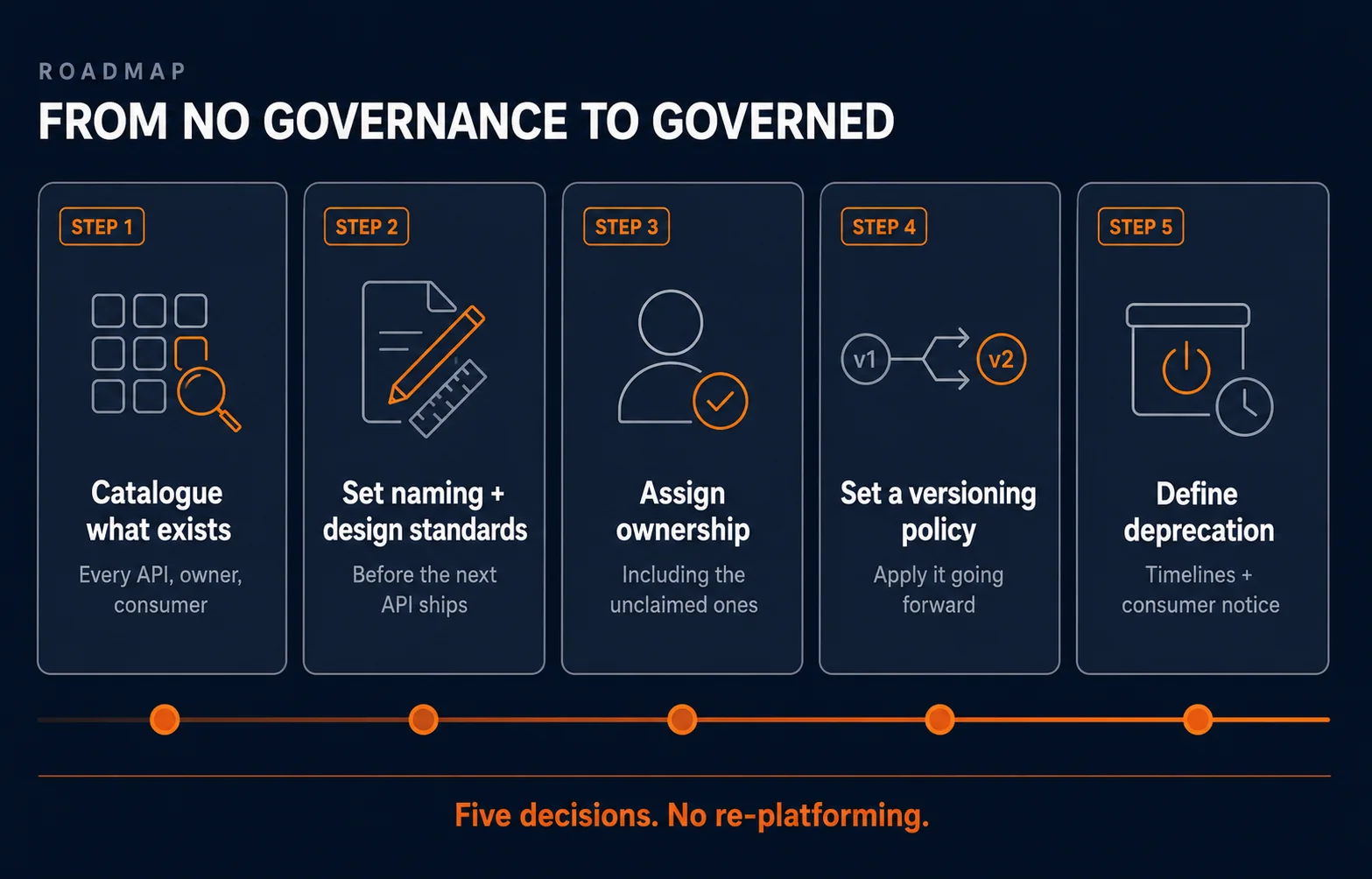
The starting point is visibility. Before defining standards, build a catalogue of what already exists: every API currently running, who built it, which systems consume it, and whether it has an assigned owner. Most organizations find gaps they didn't expect.
From there, the priorities are:
- Define naming and design standards before the next API is published
- Assign ownership to every existing API, including the ones nobody wants to claim
- Document which systems consume each API. This is the prerequisite for safe deprecation
- Set a versioning policy and apply it going forward
- Establish a deprecation process with defined timelines and consumer notification
None of this requires replacing SAP API Management or changing the underlying architecture. It requires decisions that should have been made earlier and can still be made now.
How AiFA Labs Supports SAP API Governance and Integration Strategy
At AiFA Labs, we work with enterprise SAP teams at the point where strategy meets execution. Through our SAP BTP Services, we help organizations move integrations from legacy middleware platforms to SAP BTP Integration Suite, design clean-core extension architectures, and build the governance patterns that SAP API development projects typically skip.
Our delivery runs on SASA, an AI-powered SAP development engine that automates code generation, iFlow creation, impact analysis, and test case production across the SAP landscape. For teams dealing with integration debt (duplicate APIs, undocumented consumers, or a MuleSoft-to-BTP migration) SASA reduces the manual effort that makes those projects slow and expensive.
Beyond migration, we design the architecture that prevents the same integration debt from building back up. Clean-core compliant extension patterns, defined integration standards, and SAP-aligned AI roadmaps are part of how we close out a project, not afterthoughts.
We hold ISO/IEC 27001:2022 and SOC 2 Type II certifications and work with clients including Capgemini and Wipro, with offices across the US, India, Brazil, Turkey, and Guyana.
If your SAP API landscape has accumulated technical debt or your team is planning a BTP migration, talk to our team about where to start.


