.svg)

Most enterprise SAP teams already have a Clean Core report. What they don’t have is a way to keep the core clean once the report is six weeks old.
With mainstream maintenance for SAP Business Suite 7 core applications ending at the end of 2027, Clean Core has moved from guidance to delivery pressure. SAP customers are migrating, extending, and layering AI on top of S/4HANA at the same time. Many are also creating new technical debt while they remediate the old debt. A point-in-time assessment cannot keep up.
This piece is for SAP leaders who already understand the principle and need a working model: what continuous Clean Core actually looks like across requirement intake, design, development, release, and monitoring; where teams consistently get stuck; and what changes when AI-assisted development enters the SDLC. We work in this space, so we have a point of view, and we’ll be transparent about where AiFA Labs fits in the picture.
In short: SAP Clean Core is the practice of keeping the ERP core close to standard and upgrade-safe while using approved extension, integration, automation, and application layers for innovation. In 2026, the challenge is not only assessing Clean Core once. It is maintaining Clean Core compliance continuously as new requirements, AI-assisted code, integrations, and SAP BTP extensions enter the delivery cycle.

TL;DR
- SAP Clean Core is a continuous operating practice, not a one-time report.
- A point-in-time assessment cannot prevent next quarter’s technical debt.
- The leverage is in requirement → generation, not in post-release review.
- AI-assisted development often requires Clean Core review before output is production-ready, which makes pre-generation controls a 2026 priority, not something to defer.
- Track the A/B/C/D level trend, not just absolute counts. Direction matters more than the snapshot.
- AiFA Labs concentrates on the generation step, where most SAP programs currently have the least governance.
The Honest Clean Core Baseline
In enterprise SAP conversations this year, four issues keep coming up:
- AI-generated ABAP often requires Clean Core review before output is production-ready. In our experience, first-pass output usually needs remediation before it lands as upgrade-safe. That’s the gap between “the code runs” and “the code is Clean Core compliant.”
- Level D objects rarely get cleaner on their own. Programs that don’t actively measure Level D distribution end the year with more Level D, not less.
- The exception backlog grows faster than the remediation backlog. Most enterprise SAP programs add Clean Core exceptions every sprint. Most review them quarterly, at best.
- AI-assisted development compresses the cycle that used to slow technical debt down. Whatever friction kept ABAP customizations rare is gone. Governance has to move closer to the work, or the work will outrun governance.

The common problem is timing. Clean Core controls often appear after the risky decision has already been made. A report at the end of a quarter cannot fix a decision from week two.
In 2026, discovery is no longer the hard part. Control placement is.
Requirement → architectural intent → technical spec → generation → validation → release → monitoring.
Clean Core compliance has to be enforced at every stage, not only at the last one. Tools and reports that only inspect production-ready output leave most of the gain on the table.
What SAP Clean Core Actually Means in 2026
SAP defines Clean Core as a set of guiding principles that support continuous business transformation by helping organizations design agile, innovative, and efficient ERP systems. In practice, that means keeping the ERP core close to standard and upgrade-safe while allowing innovation through approved extension, integration, automation, and application layers. SAP’s Clean Core materials point beyond custom code. Extensibility, data, integrations, processes, and operations all affect whether the core remains clean.
For an enterprise SAP team, that translates into five disciplines at the same time:

- Fit-to-standard as a permanent discipline, not a project methodology that ends at go-live.
- Intentional customization with a documented reason, an approved extension pattern, and a visible owner.
- Innovation decoupled from the core, including SAP BTP, side-by-side applications, released APIs, event-driven integrations, and governed ABAP Cloud patterns.
- Data and integration discipline equal to code discipline. A core can look clean technically while running on inconsistent master data and brittle interfaces.
- Measurable operations. Clean Core needs KPIs, dashboards, exception tracking, and ownership, not just architecture preferences.
Clean Core lives in repeated delivery decisions across the SAP lifecycle. Every new requirement asks the same question: standard SAP, configuration, in-app extensibility, developer extensibility, SAP BTP, process automation, integration, or a formally governed exception?
Those repeated decisions determine whether the core stays clean.
Clean Core Report vs. Continuous Clean Core Practice
A Clean Core report is useful. It gives leadership a snapshot, identifies current risk, and supports roadmap planning, migration strategy, remediation, and executive alignment. It is not the problem.
The problem is that a report cannot govern tomorrow’s work.
| Dimension | Clean Core Report | Continuous Clean Core Practice |
|---|---|---|
| Timing | Point-in-time | Embedded across the SAP SDLC |
| Purpose | Identify existing risk | Prevent new risk from entering the core |
| Custom code | Reviews what already exists | Applies controls before release |
| Extensions | Classifies current extensions | Guides where each new extension belongs |
| Integrations | Documents known interfaces | Monitors integration patterns and API usage |
| Compliance | Reactive | Continuous and measurable |
| Leadership visibility | Static findings | Trends, exceptions, accountability |
| AI readiness | Indirect | Built into development and governance |
| Business value | Helps plan cleanup | Sustains modernization and innovation |
A report says where you are. A practice says how you stay there.
For Heads of SAP, this becomes a governance question. For Program Directors, a delivery model question. For Enterprise Architects, a pattern and compliance question. For all three, the answer is the same: Clean Core has to move closer to the work that creates the risk.
SAP Clean Core Compliance Levels: The Shared Language Most Programs Are Missing
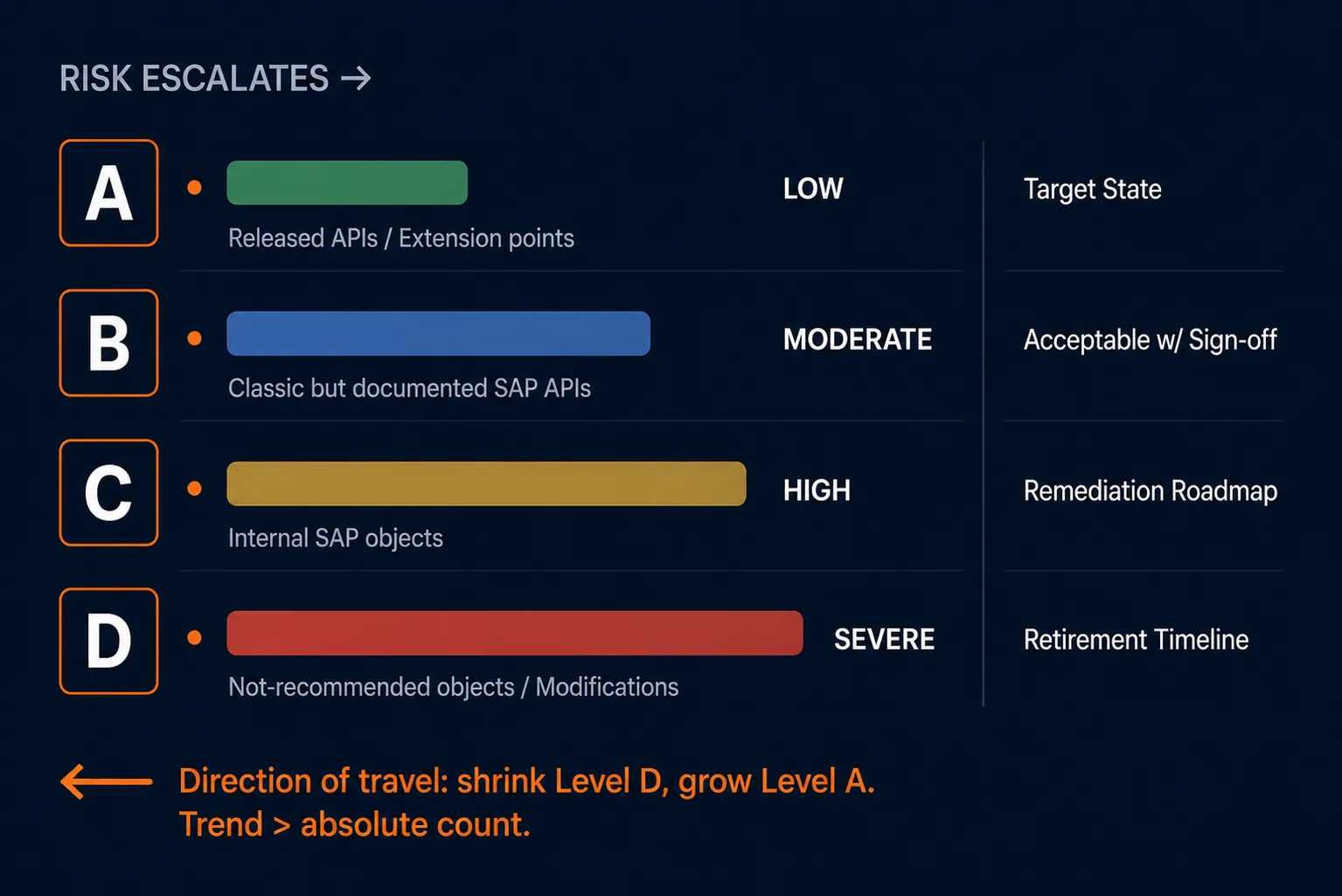
SAP Cloud ALM gives teams a structured A–D level framework to classify customer objects and manage upgrade risk. The same levels drive extensibility KPIs across Cloud ALM dashboards.
| Level | Meaning | Leadership interpretation |
|---|---|---|
| Level A | Released APIs and extension points (ABAP Cloud or BTP side-by-side) | Target state for all new development |
| Level B | Classic but documented and generally stable SAP APIs | Acceptable with governance sign-off |
| Level C | Internal SAP objects, meaningful upgrade risk | Belongs on a remediation roadmap |
| Level D | Not-recommended SAP objects, noAPI designations, and modifications | Severe upgrade exposure — needs a retirement timeline |
The level model matters because it replaces “we have technical debt” with a portfolio view. Not every object needs the same response. Level A and B reinforce confidence. Level C triggers review. Level D triggers a decision: remove it, refactor it, replace it, or formally accept the risk with a named owner and a sunset date.
In practice, the most useful Clean Core metric for SAP leadership is not the absolute count at any level. It’s the direction of travel between releases. If Level D is shrinking quarter over quarter, the operating model is working. If Level D is flat or growing while the team reports remediation progress, exceptions are entering faster than they’re being closed.
SAP Cloud ALM supports this view directly through extensibility KPIs: technical debt score, customer object execution, business modifications, unused objects, and clean core share. SAP recommends running ABAP Test Cockpit checks weekly so the data stays current.
A Continuous Clean Core Workflow: Where SAP Clean Core Automation Belongs
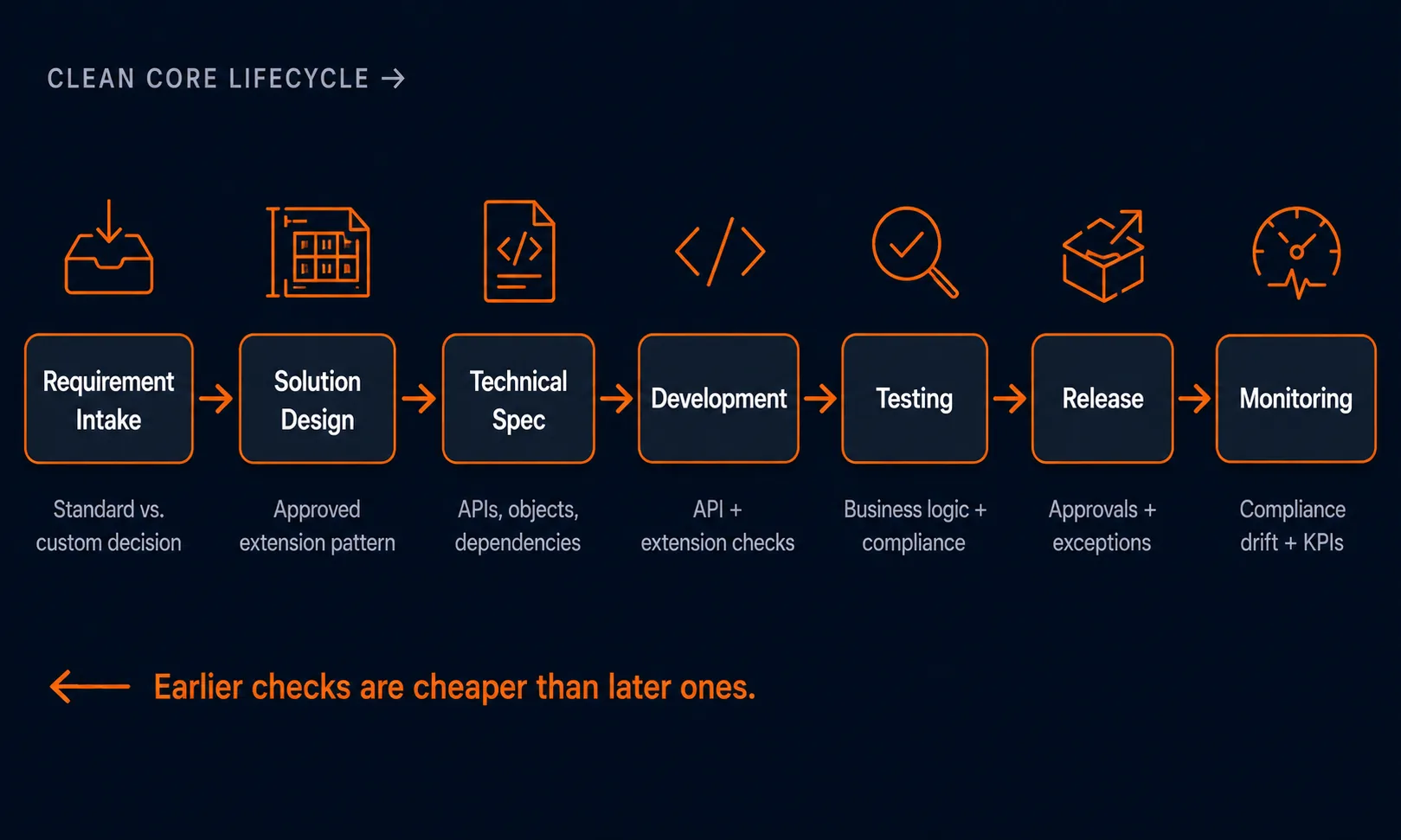
Clean Core needs to be embedded into the way SAP work moves from idea to production. The control point cannot sit only at the end of development. By then, the technical decision has already been made, the code may already exist, and the program is already under release pressure.
The pattern that works:
| Stage | Clean Core practice | Why it matters |
|---|---|---|
| Requirement intake | Decide between standard SAP, configuration, extension, automation, integration | Prevents unnecessary customization before design begins |
| Solution design | Confirm the approved extension pattern and target architecture | Keeps innovation aligned with the strategy |
| Technical specification | Document APIs, objects, data dependencies, compliance expectations | Reviewable evidence before development starts |
| Development | Apply custom code, API, and extension checks | Reduces compliance risk before testing |
| Testing | Validate business logic, regression, Clean Core compliance | Avoids late-stage rework |
| Release | Record approvals, exceptions, remediation plans | Creates governance evidence |
| Monitoring | Track compliance drift, custom objects, business modifications, integration changes | Keeps Clean Core measurable over time |
At this point, Clean Core becomes practical. Requirement intake should challenge whether the business need requires customization at all. Solution design should confirm the pattern before code exists. Technical specification should document which APIs are touched. Development and testing should apply automated checks. Release should record what was approved and what was excepted. Monitoring should show whether the landscape is improving or drifting.
The earlier a Clean Core decision is made visible, the cheaper it is to correct.
Where SAP Teams Get Stuck
Clean Core rarely fails because leaders disagree with the principle. It fails in execution. A few patterns that show up consistently:
 The Report Trap
A Clean Core assessment produces findings, but the findings don’t change how new work is received and assessed. The remediation backlog grows. New technical debt enters through the same path as before. The report becomes a periodic cleanup exercise rather than a baseline for governance.
 The Exception Trap
Every exception feels reasonable in isolation: a tight deadline, a politically difficult process, a faster integration path, a familiar pattern. The risk only appears when dozens of individually justified decisions become a portfolio of upgrade exposure. Clean Core doesn’t require pretending exceptions won’t happen. It requires making them visible, owned, time-bound, and reviewed. The question shifts from “can we make an exception?” to “what risk are we accepting, who owns it, and how will we reduce it later?”
 The BTP Dumping-Ground Trap
SAP BTP is central to most Clean Core strategies, but moving complexity outside the core does not automatically make the architecture clean. A poorly governed side-by-side extension still creates technical debt. A fragile integration still disrupts operations. A low-code application still multiplies without ownership. Moving work to BTP only helps when the architecture, ownership, and lifecycle are governed.
 The AI Acceleration Trap
AI-assisted SAP development is moving quickly from experimentation into active adoption, through Joule for Developers, ABAP MCP, agentic tooling, and generic copilots. First-pass output looks shippable, but often needs Clean Core review before it is production-ready. AI can compress the cycle that used to slow technical debt down. Without governance, it compresses the time-to-debt as well.
 The Dashboard Gap
Executives need trend visibility, not assessment-cycle visibility. Whether Level D is increasing or decreasing. Whether business modifications are being reduced. Which workstreams are creating the most exceptions. Whether compliance is improving release by release. A static report creates awareness; a dashboard creates accountability.
Most of these failures are not tool failures. They are coordination failures. They tend to ease when Clean Core checks move earlier, into intake, design, and generation, rather than living at the end of the SDLC.
Why AI Makes SAP Clean Core More Urgent
AI changes the Clean Core conversation because it changes the speed of SAP delivery. Historically, custom development was constrained by human capacity. That natural friction slowed the creation of technical debt. Every Z-program had to be specified, written, reviewed, and tested by people. AI removes most of that friction.
That is valuable when the organization has strong governance. It is risky when it doesn’t.
Even when AI-assisted tools improve developer productivity, those gains do not automatically translate into Clean Core compliance. Generated code can be syntactically correct, technically functional, and still depend on internal SAP objects, fragile patterns, or extension models that the architecture team would not have approved. The bottleneck shifts from typing speed to compliance enforcement, and the compliance layer has to keep pace with whatever the generation layer is producing.
For SAP leadership, the implication is clear. If AI is going to accelerate SAP delivery, and it is, Clean Core controls have to move upstream of generation, not downstream of it. Approved extension patterns, audit trails for AI-assisted changes, review gates before code reaches the workbench, and Clean Core checks before output leaves the platform.
AI does not reduce the need for SAP Clean Core. It increases it.
How AiFA Labs Thinks About Clean Core
Most Clean Core conversations we have with SAP teams start with a remediation question (“how do we get our Level D count down?”) and end up shifting to an operating model question. Once the conversation is about operating model, the decision tends to simplify.
The remediation work matters. Custom code inventory, usage analysis, BTP migration candidates, master data cleanup, none of that is going away. But it’s the easier half. The harder half is making sure the next two years of SAP delivery don’t refill the bucket while the team is emptying it.
AiFA focuses on that earlier control point. We build SAP-aware development tooling, including SASA, our agentic ABAP code generation platform, to help teams bring Clean Core controls earlier into the development cycle, before code reaches the workbench. Specifically:
- Approved extension patterns can be introduced earlier in the generation process, so output is shaped by Clean Core expectations rather than reviewed only after the fact.
- Audit-ready evidence can be captured through the workflow, including requirements, technical specifications, plan revisions, approvals, and generated artifacts.
- The handoff into the ABAP workbench should be engineered, not improvised, so developers can refine output with stronger context and governance.
- SAP-aware context matters, because generic ABAP generation is not enough for enterprise SAP landscapes with custom tables, BAPIs, business rules, and architecture standards.
Our bet is straightforward: the biggest leverage sits before code reaches the workbench. Reports and review boards still matter. They just cannot carry the whole Clean Core operating model on their own.
Recommended Next Steps for SAP Leaders

1. Treat the first Clean Core report as the baseline, not the finish line. Use it to define the operating model: governance controls, remediation priorities, technical standards, and leadership visibility, rather than as a one-time deliverable. SAP’s Custom Code Migration Guide reinforces this point at the technical layer: scoping, analyzing, and adapting custom code during S/4HANA transformation makes custom code governance a practical Clean Core concern, not a theoretical one.
2. Define the extension decision tree. A clear, documented model for standard SAP → configuration → in-app extensibility → developer extensibility → SAP BTP → automation → governed exception. This single artifact prevents every new project from re-litigating the architecture discussion.
3. Embed Clean Core checks into the SDLC. Intake, design, specification, development, testing, release, monitoring. Every stage has a Clean Core question. Earlier checks are cheaper than later ones.
4. Track direction, not just absolute counts. Level A/B/C/D distribution across releases. Level D trend line. Business modification count. Unused custom object count. Recurring exception types. Workstreams that repeatedly create risk. Direction matters more than any single number.
5. Align AI-assisted SAP development with the Clean Core strategy. AI-generated specs, code, tests, documentation, and automations should follow the same governance model as human-created work. Approved patterns. Audit trails. Review gates. Pre-generation Clean Core checks. AI should execute architecture more consistently, not become a shortcut around it.
References
- SAP — What is a Clean Core?
- SAP — ERP Clean Core Strategy / RISE with SAP
- SAP Help Portal — SAP Cloud ALM Extensibility and Clean Core Levels
- SAP Help Portal — SAP Cloud ALM System View: Extensibility
- SAP Help Portal — Clean Core with SAP Build Process Automation
- SAP Support — Maintenance for SAP Business Suite 7 and SAP S/4HANA
- SAP — Custom Code Migration Guide for SAP S/4HANA

FAQ


