.svg)

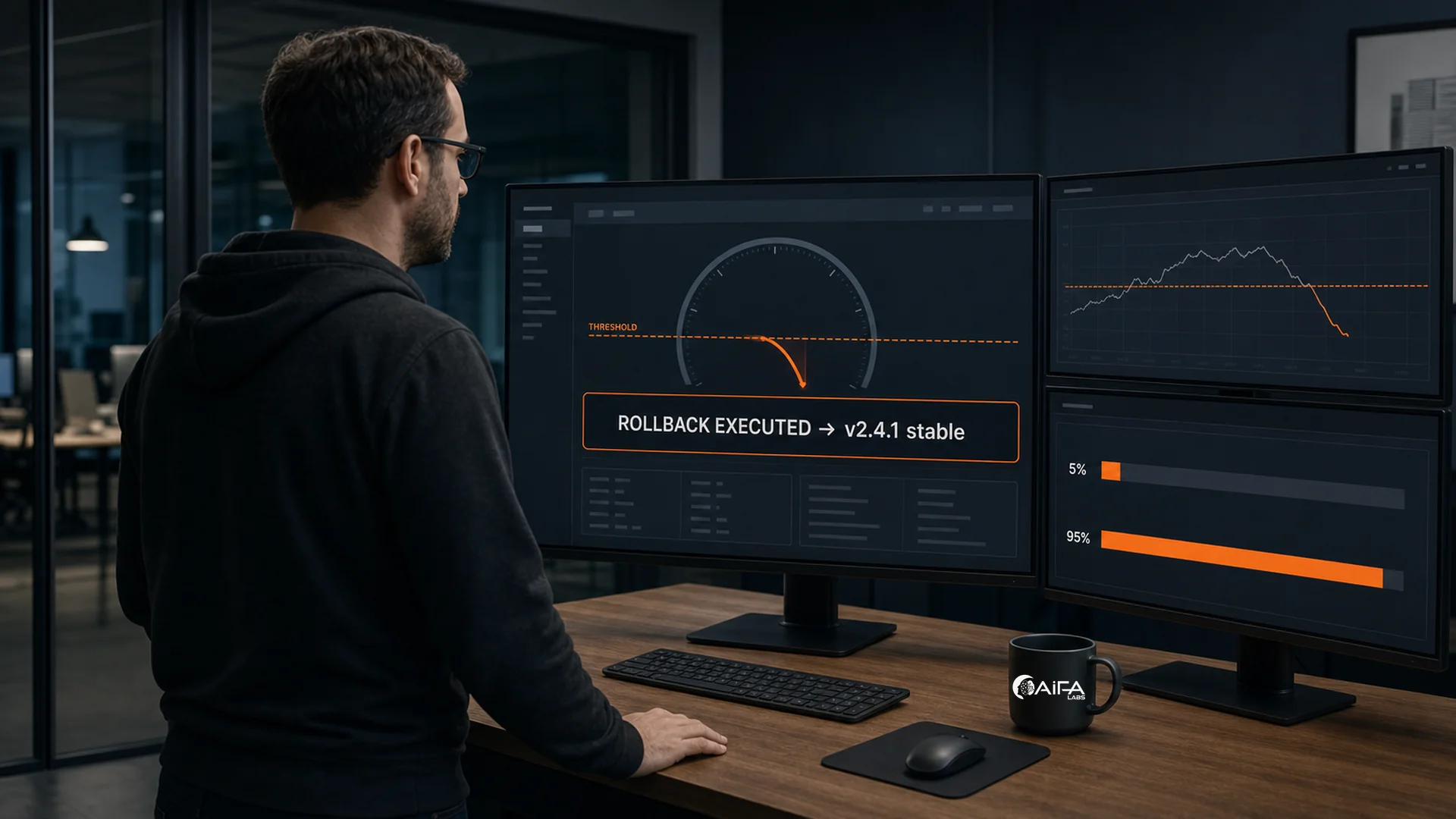
The optimal approach to safe automation requires setting AI confidence thresholds above 85% and designing automatic rollback triggers based on API error rates exceeding 2% or latency spiking past 200ms. This prevents cascading system failures by reverting to a stable state or routing to human-in-the-loop workflows before end-users experience degradation.
What Determines the Right Rollback Protocol for Automation?
Engineering teams deploying AI models must finalize their automated rollback strategy to prevent catastrophic production failures. The decision centers on establishing precise telemetry baselines that dictate when a system should autonomously revert a deployment or escalate to manual intervention. Automated rollback protocols monitor real-time telemetry against predefined confidence thresholds, reverting traffic to a stable build when error rates exceed acceptable limits. This guarantees continuous service availability even when new algorithmic updates fail in live environments.
Without strict boundaries, faulty deployments consume compute resources, corrupt databases, and trigger widespread outages. Defining the exact parameters for automated intervention requires mapping infrastructure capacity against the acceptable risk tolerance for the specific application.
What Are Best Practices for Setting AI Confidence Thresholds to Balance Automation and Accuracy?
Balancing automation throughput with output accuracy demands hard numeric boundaries on model predictions. Setting uniform thresholds across all endpoints leads to either excessive manual reviews or unacceptable error rates in production. What is the best way to implement a human-in-the-loop workflow when an AI's confidence is low? Human-in-the-loop workflows intercept algorithmic decisions when model confidence scores drop below 85%, routing the JSON payload to a human operator for manual validation. This prevents false positives from executing irreversible actions while maintaining high throughput for high-confidence predictions.
Engineers configure the deployment engine to evaluate every output against these limits. If an anomaly detection model flags a transaction with 92% certainty, the system processes it autonomously. If the certainty drops to 78%, the system pauses execution and generates a validation ticket, ensuring accuracy without halting the entire processing queue.
How Do Teams Implement Automatic Rollback Triggers in CI/CD?
Deploying code directly to 100% of users guarantees maximum damage if a bug escapes testing. Teams require deployment patterns that isolate risk. Canary deployments route 5% of production traffic to the new model iteration, monitoring key performance indicators like API error rates and processing latency before expanding the rollout. This isolates potential degradation to a microscopic user segment, allowing automated rollback scripts to revert the deployment within 15 seconds if metrics breach the established baseline.
Threshold Logic for Automated Rollback Validation
- Latency Evaluation: IF 99th percentile latency > 200ms THEN trigger immediate rollback script.
- Error Rate Evaluation: IF HTTP 500 error rate > 2% over a 30-second window THEN trigger immediate rollback script.
- Confidence Evaluation: IF average prediction confidence < 85% THEN halt rollout and alert engineering.
- System Action: IF any threshold fails THEN execute webhook to load balancer to route 100% traffic to stable legacy build.
What Are the Trade-offs Between Circuit Breakers and Conditional Gating?
Infrastructure teams must choose the correct structural pattern to handle failures without taking the entire platform offline. Circuit breakers immediately halt all traffic to a failing microservice when failure thresholds are breached, returning a fallback response to prevent cascading system outages. Conditional gating evaluates individual request payloads against confidence scores, allowing high-confidence queries to pass while blocking low-confidence edge cases.
| Feature | Circuit Breakers | Conditional Gating |
|---|---|---|
| Traffic Handling | Halts all traffic to the affected microservice | Blocks only specific low-confidence payloads |
| Primary Metric | API error rates and timeout limits | Individual prediction confidence scores |
| Fallback Action | Returns static cached response or default value | Routes to human-in-the-loop workflows |
| Best For | Preventing cascading infrastructure failures | Ensuring high-accuracy model outputs |
Considerations before implementation:
- Circuit breakers require secondary cached databases to serve fallback responses effectively.
- Conditional gating increases compute overhead by evaluating every single payload prior to execution.
- Neither approach functions correctly if the baselines for latency and error rates are calibrated inaccurately.
To implement these safeguards, engineering teams must audit their current API gateway capabilities and establish firm numeric baselines for acceptable performance.
How Does Automated Rollback Impact Operational ROI?
Financial metrics tied to uptime dictate the necessity of autonomous recovery mechanisms. Proactive rollback automation reduces mean time to recovery from 45 minutes to under 2 minutes by eliminating manual diagnostic delays. This preserves service level agreements during botched CI/CD deployments and prevents costly SLA penalties associated with extended downtime.
By relying on deterministic scripts rather than human intervention, organizations maintain 99.9% uptime even when shipping multiple updates daily. The immediate isolation of faulty code ensures that revenue-generating endpoints remain functional, validating the initial engineering investment required to build the telemetry pipelines.
Evaluate your current CI/CD pipeline infrastructure to determine if your load balancers support instant traffic shifting based on telemetry webhooks.

Frequently Asked Questions


