.svg)

TL;DR: The self-healing loop is an automated operational framework that continuously ingests telemetry data to identify anomalies, determines root causes through algorithmic analysis, executes scripted remediation, and validates the system's return to a healthy state. This detect-analyze-act-verify cycle reduces mean time to resolution (MTTR) by replacing manual incident response with programmatic interventions. It enables IT and DevOps teams to maintain high-availability service level agreements without requiring human intervention for known failure modes.
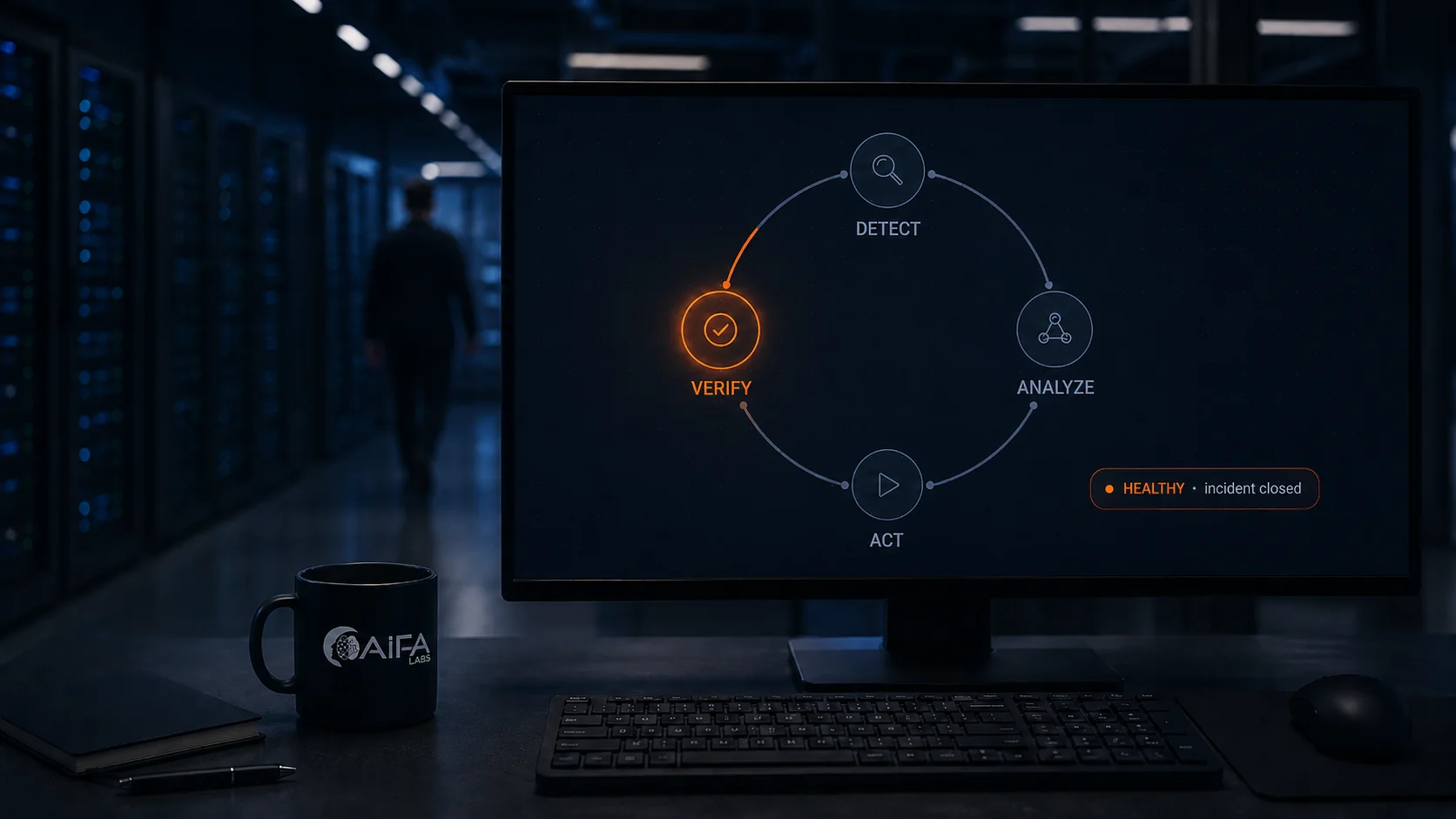
How Do Engineering Teams Evaluate Self-Healing Loop Frameworks?
Evaluating a self-healing loop requires assessing how an AIOps platform transitions from passive alerting to active remediation without introducing systemic risk. This transition dictates whether an organization scales its infrastructure safely or creates cascading automated failures.
Engineering leaders struggle to distinguish between simple runbook automation and true self-healing architectures . The core evaluation question is not whether the system can restart a pod, but whether it can contextually analyze telemetry, execute the right payload, and verify the outcome without human oversight. Understanding what is the self-healing loop in IT operations and why it is important forms the basis of this evaluation, shifting the focus from monitoring metrics to resolving incidents autonomously. A self-healing loop integrates observability platforms with orchestration engines to execute conditional remediation scripts, reducing MTTR from hours to seconds.
Why Do Traditional Incident Response Evaluations Fall Short?
Traditional incident response evaluations focus exclusively on alert routing speed rather than closed-loop remediation accuracy. This focus leaves operations teams dependent on manual triage, effectively neutralizing the speed advantages of modern monitoring tools.
Organizations measure the success of their observability stack by how quickly a webhook triggers a PagerDuty alert. This approach fails because it only solves the detection phase. When teams evaluate platforms solely on their ability to ingest logs and metrics, they ignore the analyze, act, and verify stages. Consequently, engineers still wake up at 3:00 AM to manually parse JSON payloads and execute standard operating procedures. What are the main benefits of implementing an automated self-healing system? The primary benefit is eliminating this manual intervention layer, ensuring that known anomalies trigger immediate, algorithmic correction rather than an alert fatigue cycle.
What Criteria Separate Effective Detect-Analyze-Act-Verify Loops From Basic Automation?
Effective detect-analyze-act-verify loops utilize deterministic thresholds and contextual analysis to prevent misfiring remediation scripts. This structured validation ensures that automated actions resolve the specific anomaly rather than masking underlying infrastructure degradation.
The distinction lies in the analytical and verification layers. Basic automation blindly executes a script when a CPU threshold exceeds 90%. A mature self-healing loop correlates that CPU spike with active database queries, analyzes the impact, scales the read replicas, and then verifies that latency has returned to baseline before closing the incident ticket. To properly explain the four stages: detect, analyze, act, and verify in AIOps, teams must look at the strict decision gates between each phase.
Evaluate platforms using this operational authority block to ensure safe remediation:
- Condition 1: Telemetry Confidence Score > 95% → Proceed to Analyze phase. If < 95%, abort automation and route alert to a human operator.
- Condition 2: Blast Radius Assessment → If impact is localized to a single stateless node, execute automated Act phase. If impact spans multiple stateful clusters, require manual approval.
- Condition 3: Verification SLA → System must validate the health endpoint within 120 seconds post-remediation. If validation fails, trigger immediate rollback sequence and escalate.
How Does the Cost of Bad Evaluation Surface in Production?
Inside the Site Reliability Engineering (SRE) team at a mid-sized fintech provider, the evaluation of a new incident response platform centers entirely on integration volume. The procurement scorecard prioritizes how many distinct API endpoints the tool ingests, assuming that more data equates to better stability. They deploy the platform, connecting it to every Kubernetes cluster, load balancer, and message queue in their staging and production environments. The team assumes the sheer volume of ingested telemetry automatically translates into actionable insights.
During a peak trading window, a memory leak in a microservice triggers a cascade of out-of-memory (OOM) errors. Because the evaluation missed the 'analyze' and 'verify' capabilities, the system blindly acts on the first alert it receives. It repeatedly restarts the throttled pods without analyzing the underlying database lock causing the memory spike. The automated restarts mask the true root cause, generating thousands of redundant log entries while the actual transaction processing queue grinds to a halt. The SREs spend four hours manually untangling the automated mess.
A correctly evaluated self-healing loop catches this exact failure mode before it spirals. By requiring contextual analysis as a core evaluation criterion, the correct platform correlates the OOM errors with the database locks. Instead of a blind restart, it executes a targeted payload to terminate the deadlocked queries, then verifies the queue is draining properly. The evaluation criteria dictate the operational reality: prioritizing action without analysis creates automated chaos, while prioritizing the complete loop ensures systemic resilience.
How Does AI Enhance the Self-Healing Process Compared to Traditional Automation Scripts?
Artificial intelligence enhances the self-healing process by replacing static threshold alerts with dynamic anomaly detection and contextual root cause analysis. This algorithmic approach reduces false positives by up to 40% and enables automated responses to novel failure patterns.
Traditional scripts operate on rigid "if-this-then-that" logic, which breaks down in highly distributed microservice environments. AI-driven loops assess the entire system state before taking action.
Ready to audit your incident response architecture? Download the AIOps Evaluation Framework to benchmark your current automation maturity against industry standards.
| Feature | AI-Enhanced Self-Healing Loop | Traditional Automation Scripts |
|---|---|---|
| Detection Mechanism | Dynamic baseline anomaly detection | Static hardcoded thresholds |
| Analysis Capability | Correlates events across the entire stack | Siloed alert generation |
| Action Trigger | Context-aware payload execution | Blind script execution |
| Verification Phase | Multi-metric health validation | Assumes success upon script completion |
What Are the Trade-Offs and Limitations of Implementing an Automated Self-Healing System?
Implementing an automated self-healing system introduces complexity in governance and requires rigorous testing to prevent cascading automated rollbacks. These architectures demand significant upfront investment in observability pipelines before any remediation value is realized.
Considerations before implementation:
- Not suitable for highly mutable environments: Automated actions require predictable infrastructure baselines to function safely without causing unintended outages.
- High initial configuration overhead: Defining telemetry baselines, writing secure remediation scripts, and establishing verification logic takes months of dedicated engineering time.
- Risk of masking architectural flaws: Continuously auto-restarting a failing service hides technical debt that requires a permanent code-level fix, leading to resource exhaustion over time.
Ensure your infrastructure is ready for automated remediation. Schedule a technical discovery call to map your observability pipelines today.

Frequently Asked Questions


