.svg)

TL;DR: What is the main difference between agentic and traditional AIOps? Traditional systems categorize alerts and suggest root causes, while agentic AIOps autonomously executes remediation workflows. Agentic AIOps uses large language models to read unstructured data like runbooks and tickets, allowing software agents to dynamically resolve issues without human intervention. This shifts enterprise operations from manual triage to automated system governance.
Why Do IT Operations Teams Struggle With Alert Fatigue?
Enterprise IT operations teams struggle with alert fatigue because modern infrastructure environments generate more noise than human operators can process. Teams spend the majority of their shifts acknowledging notifications, correlating events across disconnected dashboards, and trying to identify which system failure is causing a user-facing outage. The data exists, but the operational capacity to act on it does not.
This bottleneck persists because monitoring tools are designed to notify rather than resolve. When a database spikes or a container crashes, the system flags the anomaly and waits for an engineer to read the notification, consult documentation, and manually type commands to fix it. The human remains the integration point between the alert and the resolution, creating an unavoidable delay in incident response.
How Does Traditional AIOps Fall Short in Complex Environments?
Traditional AIOps ingests telemetry data and applies machine learning algorithms to cluster related alerts into a single incident ticket. This reduces dashboard noise by up to 60%, but it still requires a human engineer to interpret the clustered data and execute the remediation steps.
While clustering algorithms successfully group a network latency warning with a database CPU spike, they stop at insight. The system provides a probable root cause analysis, but it cannot take action to correct the underlying fault. Site reliability engineers must still log into the affected servers, verify the suggested root cause, and deploy the fix manually. The operational burden shifts from finding the alert to executing the response, leaving mean time to resolution largely dependent on human availability.
How Do Autonomous Agents in AIOps Create Dynamic Workflows to Solve Problems?
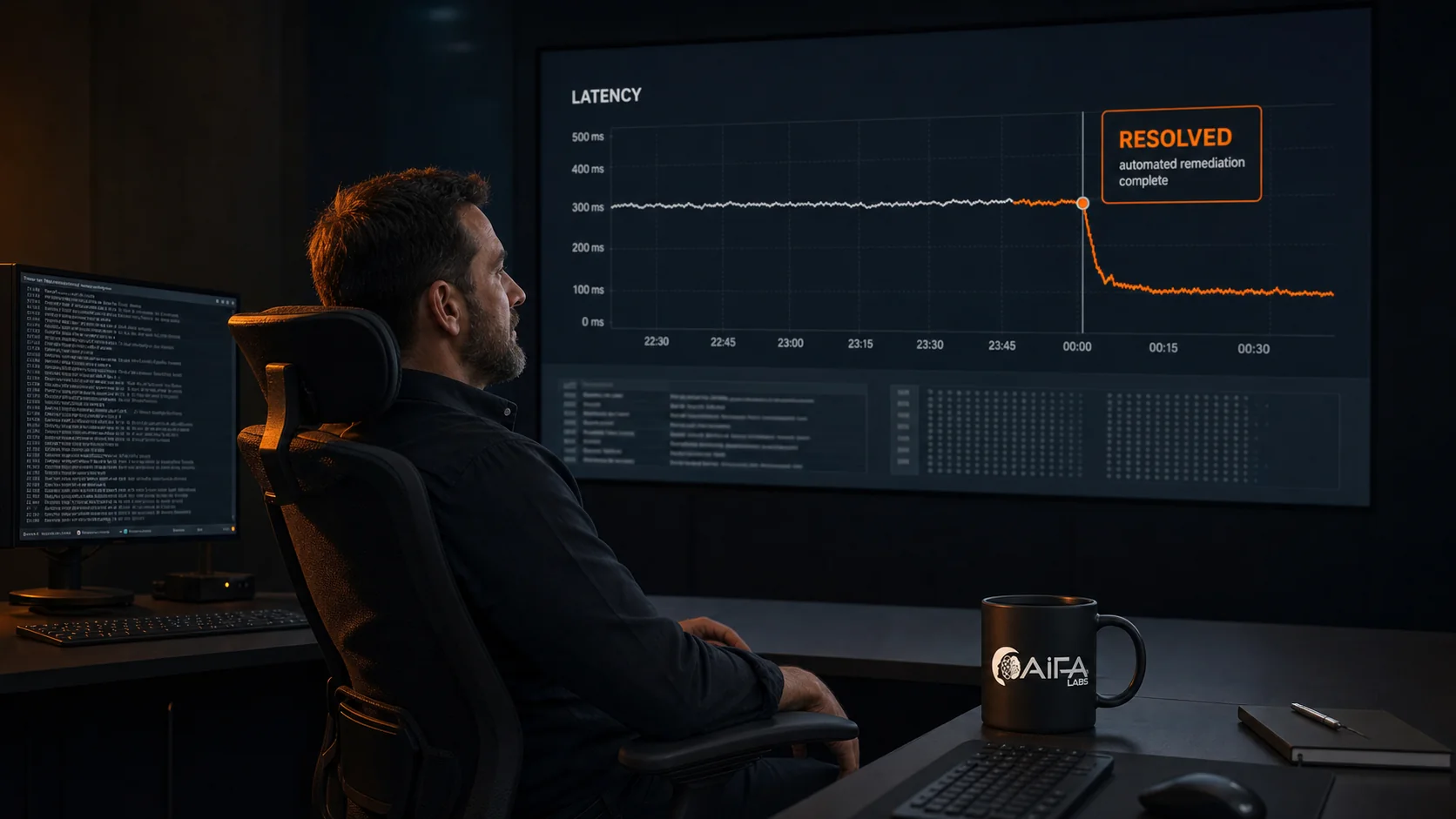
Agentic AIOps deploys autonomous software agents that utilize large language models to interpret unstructured operational data, generating and executing multi-step remediation workflows via APIs. This reduces mean time to resolution from hours to minutes by removing the human execution bottleneck.
To understand how does agentic AIOps use LLMs to understand unstructured data like runbooks and tickets, one must look at the ingestion pipeline. Instead of relying purely on structured JSON telemetry, the system reads human-written documentation, historical incident logs, and wiki pages. When an anomaly occurs, the agent queries this unstructured knowledge base to determine the correct sequence of actions. It then orchestrates a dynamic response, such as restarting a pod, reallocating memory, or rolling back a deployment, adapting the workflow in real-time based on the system's feedback to each executed step.
What Are Some Real-World Examples of Agentic AIOps Resolving Complex Incidents Automatically?
A global financial services firm experiences a sudden latency spike in its payment processing gateway during peak trading hours. An undocumented configuration drift in a secondary database cluster causes transaction queues to back up. Under a traditional AIOps system, the anomaly triggers a high-severity alert. The system clusters the network latency warnings with the database CPU spikes and routes a ticket to the site reliability engineering team.
An engineer receives the ticket, logs into the database monitoring console, cross-references the error logs against the company's internal wiki, and realizes a rollback is required. Twenty-five minutes pass before the engineer initiates the manual rollback script, during which thousands of transactions time out. The system successfully identified the issue, but the resolution remained entirely dependent on human execution.
The same scenario under an agentic AIOps framework unfolds without human delay. At the moment the latency threshold exceeds acceptable limits, the autonomous agent ingests the clustered alerts and queries the internal runbook database for similar historical anomalies. The agent identifies the configuration drift, generates a dynamic workflow to revert the database to its last known stable state, and executes the rollback via infrastructure-as-code APIs.
The incident is resolved in under two minutes, and the system merely notifies the IT operations team that the action was successfully completed. The traditional system watched the failure happen, while the agentic system actively repaired it.
What Are the Primary Business Benefits of Moving From Traditional to Agentic AIOps?
Transitioning to agentic AIOps shifts enterprise IT operations from reactive incident management to proactive system governance, significantly lowering operational costs. This evolution allows organizations to handle 10,000+ daily alerts automatically, freeing site reliability engineers to focus on architecture optimization rather than manual triage.
| Feature | Agentic AIOps | Traditional AIOps |
|---|---|---|
| Core Function | Autonomous remediation and execution | Alert clustering and root cause analysis |
| Data Processing | Understands unstructured runbooks via LLMs | Relies on structured telemetry and metrics |
| Human Involvement | Governs automated actions and sets guardrails | Executes manual fixes and investigates tickets |
| Resolution Speed | Minutes (Automated execution) | Hours (Manual intervention required) |
What Are the Governance and Security Risks of Using Autonomous AIOps Agents?
Autonomous AIOps agents introduce new security risks by requiring write-access permissions to production infrastructure to execute remediation scripts. If an agent misinterprets a runbook or hallucinates a response, it can inadvertently cause system-wide outages or expose sensitive data.
To safely deploy autonomous agents, enterprise IT teams must establish strict operational guardrails . The following evaluation checklist defines the mandatory thresholds for safe agentic deployment:
- Read-Only vs Write-Access Validation: Evaluates the ratio of automated read actions to write actions. Write-action threshold >5% of total automated responses = HIGH RISK. Action: Implement human-in-the-loop approval for all write-access workflows.
- Runbook Accuracy Score: Measures the freshness of unstructured documentation. Percentage of runbooks updated within the last 6 months <80% = FAIL. Action: Pause agentic deployment until unstructured data sources are audited and updated.
- API Rate Limiting: Monitors agent API call volume to prevent self-inflicted denial of service. Agent API call volume >100 calls/minute = CRITICAL. Action: Enforce hard throttling on autonomous execution endpoints.
Explore how autonomous IT operations can transform your enterprise infrastructure and reduce incident response times by evaluating your current runbook readiness.

Frequently Asked Questions


