.svg)

TL;DR: Governed agentic AIOps for on-premise enterprises operates as a localized intelligence layer that autonomously resolves IT incidents within strict security boundaries. The system connects autonomous agents to internal infrastructure, using policy-bounded execution to remediate issues without exposing sensitive data to external cloud networks. This approach reduces incident resolution timelines by up to 90% while ensuring all automated actions require explicit human approval for high-risk operations.
Enterprise IT teams face an unsustainable volume of system alerts and incident tickets. The scale of internal digital operations outpaces the human capacity to investigate and resolve every warning. Engineers spend hours diagnosing recurring infrastructure faults, leaving critical optimization projects stalled while they manage ongoing system instability.
Traditional automation falls short because it relies on static playbooks and rigid scripts. When an incident deviates slightly from a predefined path, the automation breaks, forcing human operators to intervene manually. This dependency on exact conditional matches causes persistent bottlenecks and prolonged downtime across enterprise environments.
How Do Autonomous IT Agents Function On-Premise?
Governed agentic AIOps connects autonomous AI agents to internal enterprise systems via policy-bounded execution environments, resolving complex IT incidents without human intervention while maintaining strict compliance. This architecture enables continuous infrastructure management without transmitting proprietary telemetry to public cloud models.
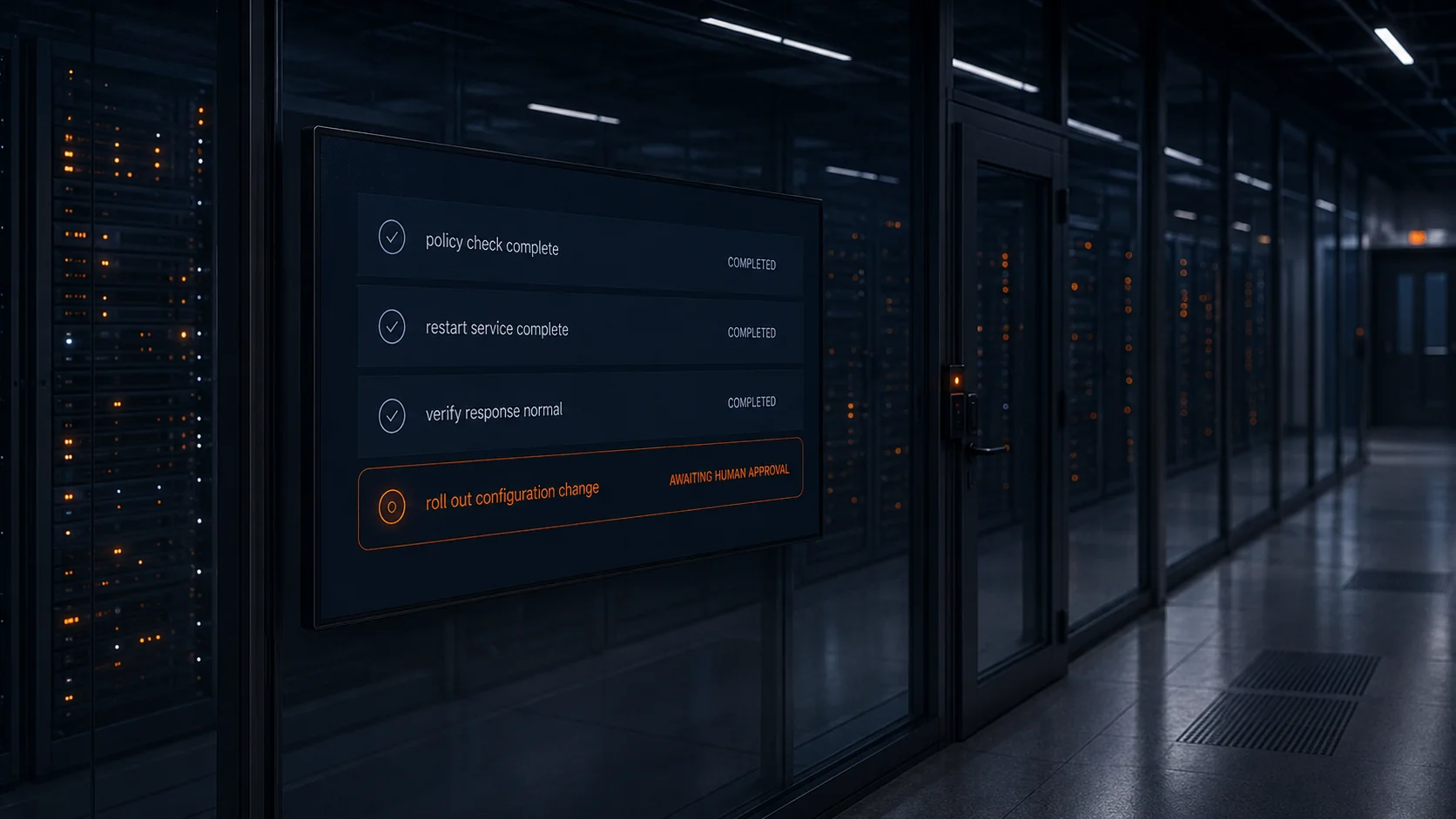
The foundational pillars for building a governed agentic AIOps framework on-premise require strict access controls and localized intelligence. Engineers establish policy-bounded execution to control autonomous IT agents and limit their blast radius, ensuring an agent cannot accidentally shut down critical production databases during an investigation. To maintain oversight, organizations define the role of a human-in-the-loop (HITL) approval process in a secure on-premise AIOps system , requiring manual sign-off before any action is executed.
How Does Agentic AIOps Resolve Real-World Incidents?
Active resolution systems process telemetry locally and execute remediation commands based on contextual memory rather than static rules. This prevents alert fatigue by replacing diagnostic notifications with completed action logs.
A database server in a regional financial data center throws a memory exhaustion alert at 2:00 AM on a Friday. The underlying application continues to process transactions, but latency spikes trigger a critical warning. The traditional monitoring system generates a ticket and alerts the on-call engineer.
The engineer wakes up, logs into the corporate network, queries the database logs, and realizes a runaway background job is consuming resources. This manual investigation takes 45 minutes, during which transaction processing degrades. That is passive monitoring working exactly as designed. The alert fired. The response required manual human translation.
The same scene under a governed agentic AIOps framework plays out differently. At minute two, when the memory alert triggers, an autonomous IT agent intercepts the signal. The agent queries the local CMDB to identify the server dependencies and establishes a secure sandboxed runtime environment. The agent cross-references the runaway job against approved termination policies. Detecting that killing the job aligns with pre-approved blast radius limits, the agent executes the termination command.
The system then pushes a webhook to the engineer's dashboard indicating that the memory alert has been resolved and Job 409 has been terminated. The engineer reviews the log the next morning. No human logged in at 2:00 AM. The agent resolved the incident within the strict boundaries of a zero-trust architecture.
How Do Enterprises Integrate Agents with Legacy Infrastructure?
Secure integration relies on dedicated API gateways and localized state management to bridge AI agents with legacy on-premise systems like CMDBs and monitoring tools. This ensures agents can read system state without retaining unauthorized access credentials.
The key differences between stateless and stateful memory for on-premise AIOps agents dictate how these systems learn. Stateless agents evaluate each alert in isolation, while stateful agents retain context about past incidents to accelerate future diagnostics. Teams implement best practices for creating a secure, sandboxed runtime environment for multi-agent frameworks on local hardware by isolating agent execution within containerized nodes. A zero-trust security model applies to autonomous agents performing IT operations within a private network by demanding continuous authentication for every API call the agent makes.
How Does Agentic AIOps Compare to Static Playbooks?
Agentic AIOps replaces rigid conditional logic with dynamic reasoning capabilities, allowing systems to adapt to undocumented system states. This shift reduces manual playbook maintenance by up to 80% annually.
| Feature | Governed Agentic AIOps | Traditional Static Automation |
|---|---|---|
| Execution Logic | Dynamic reasoning within policy bounds | Rigid IF/THEN conditional rules |
| State Management | Stateful memory retaining historical context | Stateless execution per event |
| Security Model | Zero-trust authentication per action | Broad service account permissions |
| Maintenance Burden | Low; agents adapt to new system logs | High; requires manual script updates |
What Are the Limitations of On-Premise Agentic Automation?
Deploying localized AI agents requires substantial upfront computational resources and rigorous policy definitions to prevent unintended system modifications . Organizations must evaluate their internal maturity before implementation.
- Documentation Maturity Check: IF CMDB accuracy is < 70% THEN deployment status = HIGH RISK. Action: Update dependency mapping before proceeding.
- Hardware Availability Check: IF local nodes lack dedicated NPUs resulting in latency > 500ms THEN deployment status = FAIL. Action: Upgrade edge hardware.
- API Accessibility Check: IF legacy systems lack REST endpoints and integration cost > $100K THEN deployment status = HIGH RISK. Action: Deploy middleware translation layers first.
What Steps Should Teams Take Next?
Transitioning to governed agentic AIOps requires a phased approach, beginning with read-only agent deployments to build organizational trust. Teams validate agent reasoning against human diagnostics before enabling write access.
Organizations exploring this architecture should audit their existing CMDB accuracy and begin defining human-in-the-loop thresholds for critical systems to prepare for localized agent deployments. Start by evaluating which legacy systems support the API integrations required for secure sandboxed runtime environments.

Frequently Asked Questions


